EP 05 . SEASON 01
How to Measure Brand in a Zero-Click World | Jenny Coppola x Bitly
Follow:
EP 05 . SEASON 01
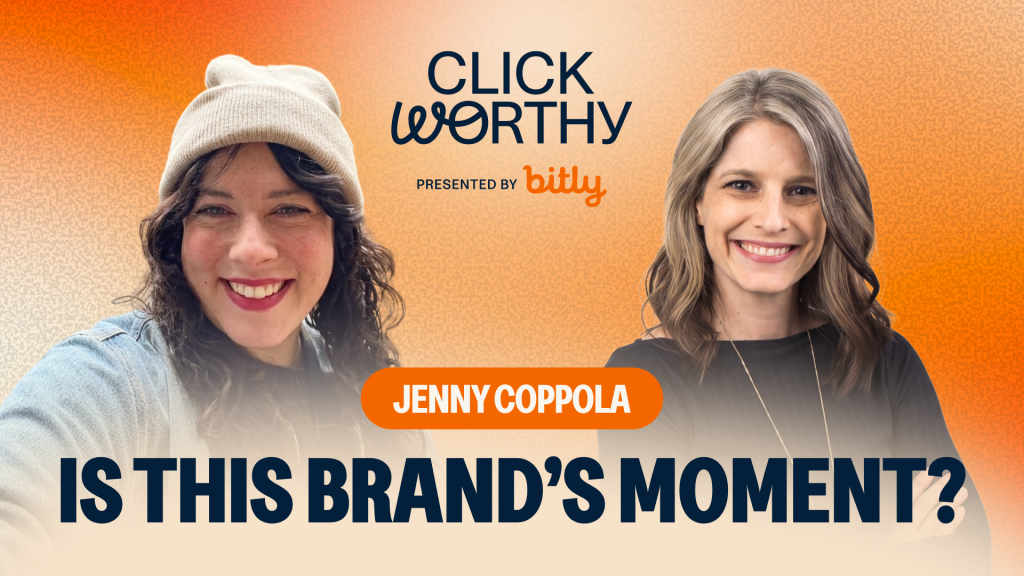

How do you measure brand when the click disappears? On this episode of Click Worthy, Jenny Coppola, Senior Director of Brand and Content at Bitly, shares how her team tracks brand health, earns AI citations, uses Reddit to get discovered, and makes content worth clicking.
What you’ll learn:
Guest Bio:
Jenny Coppola is the Senior Director of Brand & Content at Bitly, where she leads brand, content, social, and thought leadership. She has over a decade of experience helping B2B tech companies turn complex ideas into clear, compelling stories that connect with people and build lasting brand trust.
1:47 Jenny’s first Bitly moment (a custom domain at Wistia)
2:41 What zero-click means for brand teams
5:42 What is brand, anyway?
6:28 Is this brand’s moment? Reddit, GEO, and AI Overviews
11:01 What is Bitly’s Reddit strategy
14:34 How to measure brand with a brand health score
19:33 Dark social, screenshots, and content worth the click
27:10 Human-led content in an AI slop era
31:39 Fill in the blank + Click or Scroll
Tara Robertson: Thank you so much for coming. Today I’m here with Jenny Coppola, our head of brand and content at Bitly. Jenny, before we get in, tell us a little bit about yourself and your background. What brought you to Bitly?
Jenny Coppola: I lead our brand and content team, but I’ve been in brand and content for 13-plus years now, always in B2B SaaS. That’s been my background through and through. I started out as more of a marketing generalist. I was an assistant doing everything, so designing…
Tara: You’re so good at everything.
Jenny: It forced me to learn Adobe better when I was super young. Then I moved into social, then content, and led creative teams. I’ve always been in this branded content zone. It’s been my focus and my passion throughout my whole career, and I’m still doing the same thing and I love it.
Tara: Amazing. Before we get into brand and content and everything that’s changing, do you remember your first Bitly moment?
Jenny: Yes. After I was a marketing assistant, I worked at Wistia in a social media role. I was like, I can’t be posting these really long links with all these parameters. So I made the case to get Bitly, a paid plan, and a custom domain. I was looking the other day, and I’m pretty sure they still use it as their custom domain for short links. A little plug. That was over 10 years ago, my first experience with Bitly, and I’ll never forget it.
Tara: And here we are.
Jenny: Here we are now. Full circle moment.
Tara: All right, let’s jump in. Part of what we’re talking about today, and on this podcast in general, is being click-worthy. In a world where everyone’s talking about zero-click and the dark funnel, how do you build content that engages? Especially as a company that talks a lot about clicks, we believe clicks absolutely still matter. The difference is, how do you make sure a click is worthy? How do you make sure what people click on actually gets them to the outcome they’re looking for? Jenny, you’re head of brand and content, sitting at the forefront of all of this. When you hear zero-click, what does that mean for you?
Jenny: There’s so much change going on, and it’s happening really quickly. But at the same time, we’ve always had to adapt rapidly. One thing that comes to mind is from Wistia, when I was in the social role. Slack was just starting to take off. Imagine a world without Slack. It was really popping off at the time, and we were worried that if everyone started sharing things on Slack, we’d lose that tracking. We wouldn’t see what content was resonating, because it’s dark social. It’s essentially word of mouth, but in a digital space.
So we’ve always been trying to figure out how to navigate things we can’t track. As marketers, we’re obviously obsessed with tracking things, which is great. But for brand in this zero-click world, there are different signals to look at. Maybe traffic isn’t as important, or it’s not the one thing we’re focused on. Instead, we look at other signals that tell us whether the content we’re creating is resonating with our audience.
Tara: What does brand and content look like for you now?
Jenny: We’ve gone through a journey over the past several years, and this is probably true for a lot of brand teams. We used to be more focused on awareness and impressions, on getting our message out there and what we’re saying. In this new era, we’re more focused on what other people are saying about us. Brand has always cared about that, but now it feels even more important. We can talk about how great we are and the messages we want to get out there. But are other people saying that? Are our customers saying that? Are they leaving reviews that drive home the message we want? So we’re trying to influence the perception and sentiment of our audience, and also of LLMs and robots, so everyone understands what’s unique about Bitly and what makes us different.
Tara: What is brand? When you think about brand, is it the name Bitly, or is it something that just exists? Going off script. Sorry.
Jenny: This is great. I love this meta question. What is brand?
Tara: What is brand?
Jenny: Where are we? Who am I? I do like this. Brand is made up of so many different components. One thing I’ve been really focused on is the entire experience. Obviously, it’s what we control and what we say. It’s what other people say. It’s also how our existing customers experience us, from the first time they interact with us to a support conversation. It’s all parts of the whole.
So when we report on brand, we try not to rely only on the traditional vanity metrics we might have focused on in the past. We bring in data points from other parts of the business, the general sentiment on social channels and in the tools we use, and the sentiment in LLMs and the search results we show up in. It’s a lot of things. It’s a feeling. It’s something you can’t touch or fully describe, but it’s super important. As a brand person, I think brand is always having its moment. But right now, it’s especially important for businesses. How you show up, online or in person depending on your business and industry, is so influential to how people understand what you do and what you offer. Not investing in it is really setting yourself up…
Tara: That’s the part that’s so fascinating. Hopefully we’re talking to some marketers listening to this. For marketers, brand has always been the hard thing to invest in, and the hard thing to justify the level of investment it needs. It’s in a really interesting space right now. For the first time, I hear investors, boards, VCs, and executives talking about the importance of brand. It’s always been the thing where you had to figure out how to get your brand budget in and how to talk about its value, because it’s a feeling and an experience. Everybody experiences the brand. Your reputation can be something you manage, own, and build with the rest of the organization, or it can manage itself for you. So do you think this is brand’s moment? What does that mean?
Jenny: I do. When I go on LinkedIn, and I don’t know if it’s just the targeting, a lot of the posts I see are about brand having its moment right now. I think it’s converging with other areas of marketing. Before, brand was harder to measure. We had certain signals that told us if we were moving in the right direction, like a brand awareness survey, which is great information about whether people know you exist. But now, the channels and areas we’re prioritizing to impact visibility or sentiment are more measurable, in different ways, and closer to acquisition than they’ve ever been.
One good example is Reddit. Reddit used to be a place where businesses were like, don’t go near it. Everyone could sniff you out a mile away. That’s still true. You have to show up authentically. But businesses can now have a Reddit strategy, organically and from a GEO perspective. One thing we saw recently is the convergence of brand, SEO, and GEO. We had a blog post ranking in the top 10 results for “what is a vanity URL.” We said, what if we replicated that, put a twist on it to add new value, and created our own post in our own subreddit about “what is a vanity URL”? Within a few days, which was really cool, both the subreddit post and the SEO post were cited in AI Overviews. So now we’re taking up two of the five slots in AI Overviews for “what is a vanity URL.”
That sounds very SEO and acquisition and not so much brand. But when you think about the community you’re building in your own subreddit and the conversations you’re driving, it’s still brand focused. It’s still about the perception of the brand and what we care about talking about. It’s just more measurable now and tied closer to impact, which really helps make the case for brand.
Tara: So cool. Let’s go into that, because the more people I talk to externally, the more they ask which channels we’re investing in and how we think about measurement. I want to dig into measurement too. But how has the team been investing? What does your Reddit program look like right now? How are you thinking about channels that historically might have been owned by social, like YouTube? And how are you partnering with our acquisition teams? Like you said, brand has always been about creating impressions, building awareness, and building a strong brand. Now it’s, how do I build that so it’s measurable and impactful, supports owned and earned media, and partners with the rest of the organization?
Jenny: A few years ago, like I said, Reddit wouldn’t have even been a channel we’d consider. So there are a lot of new and emerging channels, or existing ones we’re looking at differently.
Tara: Or it never showed up on the top priority list. Community always sounded cool, but we didn’t quite know its impact, so it sat over here.
Jenny: And it’s tricky, because the sentiment now is that you need to be everywhere. Marketing always goes back and forth between “show up everywhere” and “show up where your audience is.” Now it feels like we need to show up everywhere because LLMs pull from everywhere. But we’re thinking about it differently. Measurement, and understanding where citations are already showing up, is really important. We know we get a lot of citations from YouTube, and it’s a big organic channel for us. So from a brand perspective, people are already talking about Bitly on YouTube, which means we should talk about Bitly on YouTube and show up there too.
For any brand, it’s important to find out where people spend their time, create an organic way to enter those spaces, and then figure out if there’s a play to push harder on the marketing side. You really want to thread the needle, because some of these channels are so sensitive.
On Reddit, we have an organic strategy mixed with GEO. We engage in conversations about our brand, or about topics related to what our products offer and how we help customers. On YouTube, it’s creating content that meets demand, because people are already looking for this information. It’s also creating content that’s educational, inspirational, and thought leadership.
So it’s a mix. We’re experimenting with new things: piloting something, learning from it, then deciding whether to invest more. I think that’s a shift for brand in general, and other brand teams can probably relate. The long runway of build up, build up, build up, campaign moment, and then it’s out there? Those days are kind of gone. Now we’re launching, testing, doing it again, and trying to learn quickly so we can figure out where to invest. A lot of teams are probably going through that change.
Tara: One thing that’s been really surprising to me is the balance of GEO, or answer engine optimization. There are so many acronyms. But specifically, how do you build a motion that helps with LLMs and AI search, so you show up where people are coming in? What’s most surprising is seeing that balance happen across all of marketing. In the past, acquisition was the acquisition team’s job. But some of the metrics out there show upwards of 55 to 60% of your SEO is actually influenced by your brand. And over the last year, I’ve never seen press releases ranking at the rate they’re ranking. Or, like you mentioned, you flip a piece of content and it shows up much faster when it comes through channels like Reddit or YouTube. It’s a fascinating world. How has tracking changed for you? How are you measuring the impact of brand, and how do you report it to the company to bring people through these changes?
Jenny: It’s tricky. There’s a lot more to measure, and there are different ways to look at it. Historically, brand has always been that nebulous thing. We know it’s important and we’re going to invest in it, but how do we measure ROI? Now, with a more channel-focused approach to things like reputation management, we can understand how people feel about the brand, report on it, and report on how that changes over time. Pair that with social or LLM sentiment, and now you have a feeling number, which you never had before.
Tara: Love a feeling number.
Jenny: It’s great. I can say, this is where we are today, this is where we were last month, and this is the direction we hope to go. Then on the visibility side, we can look at impressions for branded search terms over time. All these tools change every month. The way we report on branded mentions in LLMs keeps changing. Is it average daily mentions? Cumulative mentions? But there’s always some proxy now that shows whether we’re heading in the right direction. Directional data is super helpful for brand, because brand fluctuates so much. A handful of negative comments could tank your brand health one month, and it could recover the next. It’s similar to the volatility of whether you’re showing up for a prompt. It can change so quickly.
Right now, we have a brand health metric. It’s like a report card: we’re a B+, we’re an A+. It combines a bunch of different numbers and helps us see which direction we’re going. That’s something I couldn’t have pointed to a few years ago.
Tara: Let’s talk more about that, because it’s so fascinating, and you built it internally with one of our analysts. Can you explain what brand health is? It didn’t exist before. We built a new way of looking at it. That’s been impactful for the brand team, but also for educating the entire company. Like we said about acquisition, brand has always been owned by a brand team, but everybody owns brand. Areas like reputation management and customer care on social tend to live in partnership with your customer support or success teams. So how did you build this? What metrics make up the brand health dashboard, and how do you report it to the business?
Jenny: There are a few factors. One is brand visibility. That’s branded search impressions, people going into Google and typing in “Bitly.” We combine that with branded mentions in AI, or LLMs.
Tara: What tools are you using to pull this all together?
Jenny: We primarily use Google Search Console and Ahrefs, we look at AirOps for sentiment, and we use Sprout for social sentiment. We pull from a lot of different places. There’s no single source we can point to. So we came up with a way to average scores across visibility, trust, and sentiment, created an index, and added different weights. Depending on what we care about most, we can weight that score more heavily. If we really care about trust and sentiment, we can weight that at 60%, visibility at 20%, and the other at 20%. You can tinker with it to focus on what you’re trying to impact. That’s how you end up with a score, and we report on it monthly. The quarterly view is really helpful too, because even though we’re moving quickly, brand still takes a longer runway to make a bigger difference. I’m sure it’ll change next month. I’ll add a new metric or tweak it a bit. But that’s how we have to move right now.
Tara: It’s cool. Being able to look at it from our position, and even from our competitors’ position, gives a good understanding of how everybody is moving in the space.
Tara: Let’s go back to something you mentioned a while ago: dark social. Dark social isn’t new, especially in this world of zero-click versus click-worthy. We know visibility and engagement matter, but they’re also really hard sometimes. And you’ve experienced this your entire career. How do you think about dark social, and more importantly, how are you thinking about it today when you measure the impact of everything you’re doing?
Jenny: It’s an age-old problem that’s compounding now. It’s mind-blowing, honestly. In past roles, I remember looking at direct traffic and thinking, this is such a huge source of traffic to our website, and I don’t know what’s contributing to it. That’s so frustrating as a marketer. You want to do more of what’s working, but without that visibility, you’re like, I guess I’ll keep trying and experimenting. With dark social, that’s happening all the time. You might read something on social, and I do this all the time.
Tara: I love this story.
Jenny: It’s embarrassing, but it’s true. We’ll be watching a TV show at night, and I’m supposed to be paying attention to the show. But I’m on LinkedIn, cruising around, and I see something I want to read later, but not right now, because I have to focus. So I screenshot these LinkedIn posts, and later I go back to my screenshots. I’m like an old man looking at old screenshots on my phone, like, oh yeah, I want to read that whole article that person wrote.
Tara: And then you go find the article.
Jenny: Then I search for the name of the article. That poor person. Whoever’s thought leadership I’m reading has no idea where I came from. I’m searching for you.
Tara: You just look like a direct visit.
Jenny: I look just like a direct visit. And that happens all the time. They still get the click. But how do they know where it came from? Or if you text someone a link, or send someone a link on Slack, you don’t know any of that, which makes it challenging.
But especially on social, you can ask people to click. It’s not like you’ll get penalized for putting a link in your post or in the comments. But you need to make it worth it. Are you actually adding value to the conversation? We’ve always known original data is something brand leans on. Every company does state-of reports. We survey consumers or marketers, depending on the audience. Are you saying something new that hasn’t been said before? If you approach it that way and share something click-worthy, you’ll probably get the click. You just can’t spam everyone.
Tara: Talk a little about those data reports, because you did a couple last year, and they had some mind-blowing stats I still share all the time. Original data reports and average content exist for different reasons. But what impact do you see from original data reports, and more importantly, why does it matter?
Jenny: As a brand person, I’ve always been skeptical of straight-up SEO listicle content. It’s kind of a regurgitation.
Tara: This is before AI.
Jenny: Before AI. I’ve always been skeptical of that.
Tara: That algorithm tricking me into wanting to read the content.
Jenny: Yeah, I don’t love that from an editorial perspective. And now it’s like, oh boy, how often are we reading things and trying to figure out whether AI wrote it, or how much of it? I’m guilty of that all the time. But with original data and insights, you can create one really valuable thing, distribute it across channels, and repurpose it, without having to create volume to create impact. For example, last year we surveyed marketers about their QR Code usage, and that report drove 25% of our overall blog traffic. That was one asset. And this is no shade to all the other…
Tara: That’s 25% of an entire year of blog traffic from one piece of content. For context, we have a machine when it comes to SEO. We publish 40 to 50 new or updated pieces of content every month. We drive 1.5 million signups a month, and 70% of that comes from organic. So when 25% of our traffic comes from one data report, there’s no shade, because the machine is awesome. This is just outstanding. That’s the value of human-led content.
Jenny: Totally. And in this new era, this is where it gets a little less brand-y and a little more acquisition-oriented, but that’s okay. Look at existing search demand for a topic before you create the report. If there’s a high-potential keyword around, say, marketing measurement, and you want to rank for it with original data and add a new insight or narrative, do your report on marketing measurement. Still optimize it. It’s still thought leadership, and it’s still citation-worthy, because you’re adding new insights and new data. So it doesn’t have to be purely brand-led or purely acquisition. They can help each other.
Tara: That’s where earned media comes from too. People want to report on and talk about content that’s original and clearly not AI slop. Which leads to one of the big topics we’ve been discussing: human-led marketing, the approach and why it matters. You’ve said a few times before this conversation that human-led is still a strong differentiator, especially in branded content. Can you touch on that?
Jenny: Totally. Anytime there’s a huge swing in one direction, you’ll see something happen in the opposite direction. Everyone’s obsessed with AI right now. That’s all we talk about. So for businesses, what’s a differentiator? What’s the opposite of AI? It’s human-led. I think we’ll see more businesses lean into “this video was created by humans” or “this content was created by humans,” even if it’s gimmicky or has a short shelf life. Standing behind what you create and showcasing the real voices of the people creating it is always good for brand, and it will continue to be. As marketers, we’re already in this every day. But consumers are starting to get more skeptical and weary of AI as it moves into the mainstream.
Tara: It’s about separating out when you use AI to produce, move faster, execute, and take away some of the day-to-day work. For the last 20-plus years of my career, I’ve heard, “I just wish I had more time for strategy.” That’s where AI is phenomenal. It gives you time to lean into strategy. But the brands that really stand out, and this is the belief we all hold, know that to make something click-worthy, it has to be authentic. It has to be something people want to click on. There’s definitely a world where agents connect with agents, and buying itself is likely to change. We’re going to ride that wave, have fun on it, and maybe surf alongside it. But at the same time, strategic focus, taste, and being a strong brand with a human-led approach have never been more important. You can tell the difference. You know I love AI, but I truly believe that to connect with your audience, you’ve got to connect with your audience and not lose that authenticity.
Jenny: Totally. It’s super interesting to think about. I’m curious what you think. If you were a business just starting out, with nothing legacy feeding into AI, where would you focus your energy to influence AI and search?
Tara: I’d probably build it all with AI to get started. I know a few other CMOs who’ve gone to startups because they can build things in a completely different way. And honestly, the marketing team here at Bitly has done an incredible job shapeshifting how we work. But it doesn’t change the job at the end of the day, which is, in your case, creating great content, or driving strong demand. We can just do it faster.
Jenny: Totally.
Tara: Anthropic is a great example of doing it differently. There’s all this clickbait out there saying, “I vibe coded my marketing team in five days with these workflows.” Then you look at Anthropic’s hiring. Their job descriptions say they believe in AI for productivity, and they also believe in humans who bring strategic creativity to the table. They’ve been hiring like crazy on the marketing side. So if I were building something new, I’d take that approach: use AI to be efficient and fast and build a completely new way of working, but put a human-led approach on top of everything you do. Someday your buyers might be agents, but right now they’re still humans. So we’re connecting with them and building things that are authentically us. Everybody can see through AI slop, especially in LinkedIn posts, where it’s like, “What I’m most impressed by is…” or…
Jenny: “It’s not this, it’s this.”
Tara: Exactly. Or the em dash. I know we both love an em dash, and now every time I see one, I’m like…
Jenny: I’m still using it. I don’t care what anyone says.
Tara: I don’t use the em dash anymore, only because I’m afraid people will think everything’s AI.
Jenny: I dare people to challenge me on my dash.
Tara: Whoever’s listening, let’s see if you can spot the real dash versus the fake dash.
Tara: All right, I’m going to throw a couple of questions at you to wrap up. First, fill in the blank: to earn the click, you need to…
Jenny: Spark curiosity.
Tara: Spark curiosity.
Jenny: Make me curious. What do you have to say?
Tara: I love that. Earn the click, get curious.
All right, Jenny, your team created this last part, which has been really fun. I don’t really know the questions, and you don’t know the questions. I’m going to ask you rapid-fire: click or scroll. Tell me whether you’d click on it or scroll right past, and then we’ll get into why. First one: a 30-part LinkedIn carousel analyzing a brand.
Jenny: Click.
Tara: Click. Why are you going to click?
Jenny: If they can show me some of the deep-dive data they’ve pulled, like from Ahrefs, where they’re like, “We saw traffic take this decline,” I want to get in there. If it’s 40 parts, I’ll give you those clicks.
Tara: There you go. We’re getting away from dark social. What about a Substack from a former VP of marketing titled “Why I Deleted Everything”?
Jenny: It’s clickbait, but I’m still clicking. Like, what did you delete?
Tara: You just like to click.
Jenny: I know, maybe. But what did you delete?
Tara: Are you taking a screenshot, or are you clicking?
Jenny: That one, I might click, read the first three sentences, and then I’m out of there. I just need to know what it was.
Tara: Why did they delete everything?
Jenny: I don’t know. Delete the hard drive?
Tara: Okay, last one: a CEO who posted their morning routine, and it starts at 3 a.m.
Jenny: I’m a hard scroll on that.
Tara: Is it because you don’t like 3 a.m., or because it’s too obnoxious?
Jenny: I just don’t like optimizing that hard. Not every part of your life can be optimized down to the minute. It’s another one of those “I drink three shots of espresso and then I run 12 miles” posts. I’m like, I don’t have time for that right now.
Tara: This is where I’m with you. Part of me does want to know their 3 a.m. routine, but it’s something I want to scroll past, mainly because I’m like, come on. We don’t need to share that on social.
Jenny: I don’t need to know all of that.
Tara: It feels braggy.
Jenny: It feels braggy.
Tara: Awesome. Well, Jenny, thank you so much. This has been so great. I get the pleasure of talking to you every day, but your knowledge should be shared with the world. Thanks for jumping in and talking about whether this is brand’s moment. I think it is.
Jenny: It is.
Tara: So thanks for being our leader and leading the charge in this moment.
Jenny: Maybe I’ll change my LinkedIn header to “This is brand’s moment.”
Tara: Brand’s moment. Awesome. Thank you.