What Is a Brand Influencer? Types, Costs, and Partnership Tips (2026)


A brand influencer is a creator who partners with a brand to recommend its products to an audience that already follows and engages with the influencer’s content. eMarketer’s March 2025 forecast puts US influencer marketing spend at $10.52 billion in 2025, with growth ticking up to 15.7% in 2026. On the creator side, 70.3% of creators named brand deals as their main revenue source in NeoReach’s 2026 survey of 434 creators.
When you work with several creators at once, results scatter across posts, platforms, links, and codes. Without a single view of those touchpoints, it’s hard to tell which creator drives sales, and budgets drift toward guesswork. This guide shows you how to choose, pay, disclose, and track brand influencers so every partnership earns its place.
A brand influencer is a content creator who partners with a brand to recommend its products to an engaged social media audience. Brands work with influencers to reach niche communities through a voice those followers already know. The goal is measurable action, like clicks, sign-ups, and purchases.
That’s how we define the term at Bitly, since no standards body offers an official definition. The FTC describes an influencer as “a person who works with a brand to recommend or endorse a product”. That line reflects everyday usage in a consumer brochure rather than a legal definition.
Brand influencers pair some of a celebrity’s reach with the relatability of a peer. Three qualities make them valuable partners:
An influencer often works with a brand campaign by campaign, while an ambassador often represents the brand long term. The Influencer Marketing Hub 2026 guide reflects this common industry framing of campaign-level versus long-term partnerships. No standards body defines “brand ambassador,” so treat these as typical patterns.
The brand ambassador vs influencer choice often comes down to how long you want the relationship to last. Many partnerships start with one campaign and grow into an influencer brand ambassador role once both sides like the results. Industry guidance, like this Make Influence guide to exclusivity clauses, notes that ambassador programs often include category exclusivity for the full contract term.
| Factor | Brand influencer | Brand ambassador |
|---|---|---|
| Relationship length | Often one campaign or a short series of posts | Often ongoing, long-term representation |
| Exclusivity | Rarely exclusive | Often exclusive within a category or across the brand |
| Compensation | Per-post fee, free product, or affiliate commission | Often a recurring fee, product, or commission |
| Content control | Creator leads the creative within a brief | Closer brand alignment and more brand input |
| Best for | Launches, awareness pushes, and testing new audiences | Sustained loyalty, community building, and product lines |
Both roles need clear disclosure, and FTC staff guidance treats the word “ambassador” on its own as unclear.
Most sources group brand influencers into four tiers by follower count: nano, micro, macro, and mega. The table below uses Influencer Marketing Hub estimates for follower ranges and per-post costs.
| Tier | Followers | Typical cost per post (IMH estimate) | Strength | Best for |
|---|---|---|---|---|
| Nano | 1,000–10,000 | $10-$100 | Close, highly engaged communities | Local launches, product seeding, and user-generated content |
| Micro | 10,000–100,000 | $100-$2,000 | Niche authority with strong engagement | Targeted campaigns within one category |
| Macro | 100,000–1 million | $1,000-$10,000 | Broad reach with established credibility | Awareness campaigns and product launches |
| Mega | 1 million+ | $10,000+ | Mass reach and celebrity-level recognition | Large-scale awareness and brand moments |
Engagement rates tend to fall as audience size grows, according to Influencer Marketing Hub. That trade-off between reach and engagement shapes every tier decision.
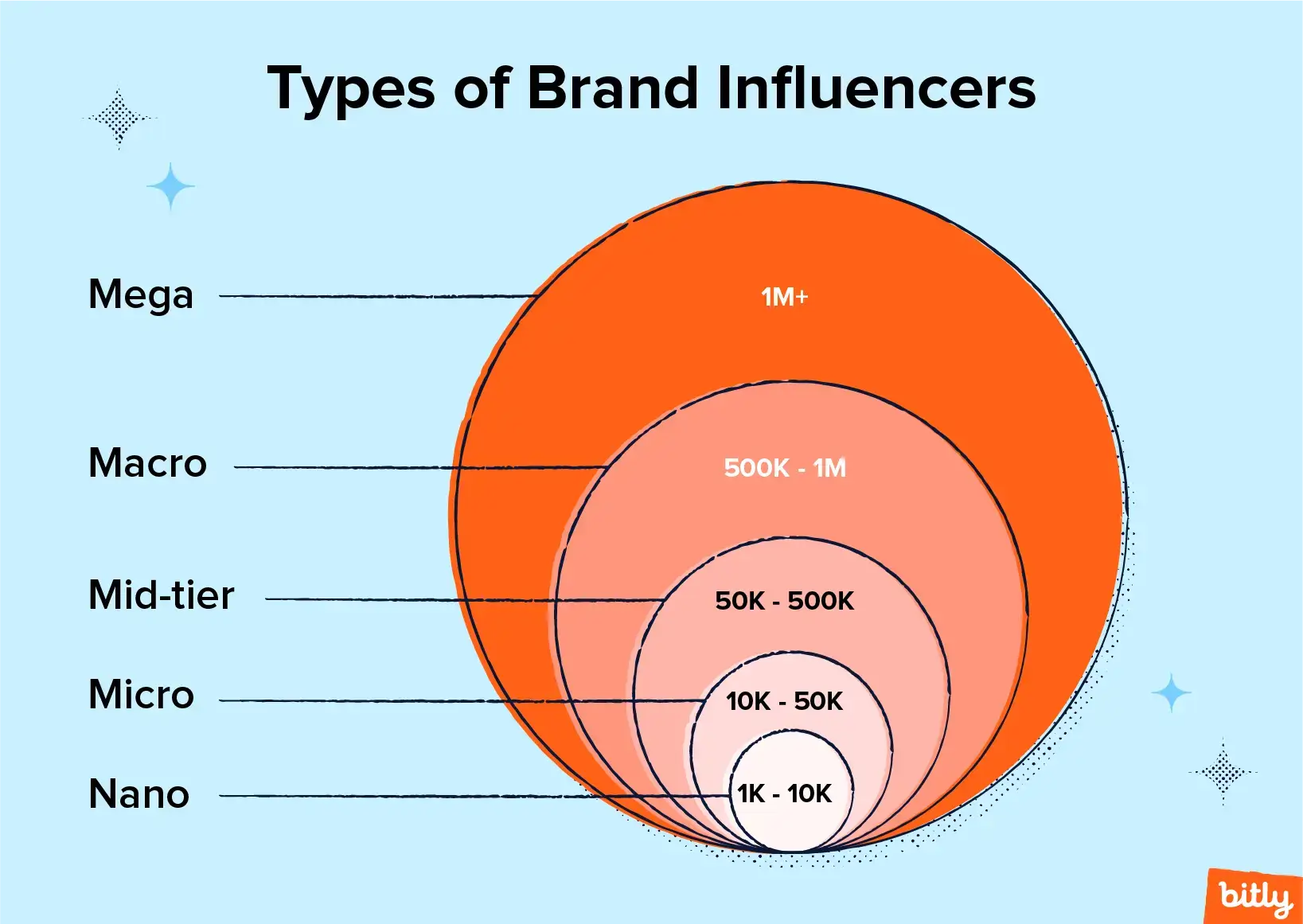
Nano influencers have 1,000 to 10,000 followers and close-knit, highly engaged communities. In the Influencer Marketing Hub 2026 Benchmark Report, the largest share of marketers priced nano creators under $500 per post. It’s also the natural starting tier for anyone learning how to become a brand influencer.
Micro influencers have 10,000 to 100,000 followers and strong authority within one niche. Followers often see them as peers, so their endorsements feel like word-of-mouth recommendations.
Macro influencers have 100,000 to 1 million followers, with audiences that can span countries. They earn credibility through consistent, high-quality content in areas like fashion, fitness, and travel. When a macro influencer endorses a product, a broad audience notices.
Mega influencers have more than 1 million followers and include celebrities, athletes, and internet personalities. They shape trends and can lift a brand’s visibility almost overnight. Their fees run the highest of any tier, as the table above shows.
Brand influencers work because people act on recommendations from creators they follow. Creators blend promotion into formats their audiences already enjoy, like tutorials, vlogs, and fitness challenges. They tell your brand story in their own voice, which humanizes your business.
Two well-known psychological effects may help explain that pull:
The BBB National Programs 2025 Influencer Trust Index surveyed more than 3,700 US consumers about their own behavior. In it, 58% of consumers said they’d bought something because of an influencer endorsement.
Trust lags behind that buying behavior. The same survey found 74% trust influencer content at least somewhat, versus 87% for general advertising. That gap gives you a clear reason to choose credible creators whose recommendations hold up.
Note: The brands and examples discussed below were found during our online research for this article.
Daniel Wellington and Glossier are two well-known brands with influencer programs. Marketing coverage often credits Swedish watch brand Daniel Wellington’s early growth to influencer gifting. An Influencer Update case study describes the brand sending free watches to Instagram micro-influencers, each with a unique promo code.
A Harvard Business Review On Strategy episode covers the growth of Glossier, which saw its best influencers as customers who love the brand. The beauty brand, born on social media, also weighed micro-influencers as it scaled.
Successful brand influencer partnerships follow four steps: choose the right creators, set fair pay, build long-term relationships, and disclose every partnership.
Choose influencers whose audience matches your customers, then vet their engagement and brand fit. First, learn your customers’ interests, pain points, and favorite platforms, like Instagram or YouTube. Our influencer marketing strategy guide covers this planning in depth.
Influencer marketing platforms offer searchable databases sorted by niche, channel, and audience demographics. A simple social media search works too. Browse relevant hashtags, see who creates trending content, and note who your audience follows.
Look at engagement rate before follower count, then run each candidate through this checklist:
Brand influencer budgets depend on tier, deliverables, and compensation model. Use the tier table above for per-post ranges, then adjust for each creator’s engagement and usage rights.
Costs keep climbing. In the Influencer Marketing Hub 2026 Benchmark Report, a survey of 600+ marketers found that rising creator costs ranked as the top challenge, at 35.4%.
Influencer brand deals usually follow one of three compensation models:
Free products count as compensation under FTC staff guidance, so gifted posts need disclosure too.
Long-term relationships make influencer endorsements more credible. When a creator shows your products regularly, followers see that they genuinely use and love your brand. Over time, the creator becomes a familiar face for your business.
Sustained collaboration also helps the creator learn your brand deeply and reflect it authentically. Long-running brand influencer programs make room for co-created content and exclusive launches. For inspiration, browse these influencer marketing campaign examples.
Start with fair compensation, since creators invest real effort in their content and audiences. Then show genuine appreciation, communicate regularly, and respect their creative freedom.
Influencers should clearly disclose any brand relationship. The FTC’s 2023 Endorsement Guides also say advertisers should monitor their endorsers’ compliance (Code of Federal Regulations, 16 CFR 255.1(d)). The points below come from FTC Disclosures 101 for Social Media Influencers. In a consumer blog post, FTC staff note that this guidance “does not contain rules or regulations.”
Hashtags like #ad are one option rather than a requirement. Clear disclosure also protects trust: the BBB 2025 Influencer Trust Index found that 70% of consumers feel deceived when they discover an undisclosed partnership.
Give each brand influencer a unique, trackable link so you can compare results creator by creator. Every click and scan then links a creator’s post to the results it drives.
A personalized influencer link is a unique short link a brand assigns to one creator for one campaign. It often uses a branded domain and a custom back-half, like yourbrand.co/maya-spring. Every click traces back to that creator, so you can compare influencers by real results.
Here’s how each Bitly product supports a personalized link for influencer marketing:
Branded links with a custom domain start on our Growth tier plan, and city-level data starts on Premium, as the Bitly pricing page shows.
Add UTM tracking so each creator’s sessions show up in your web analytics. Our guide to personalized URLs explains custom back-halves, and the influencer tracking guide walks through the full setup.
Branding pays off here too. Branded links see a 2.3x increase in clicks compared to unbranded links. Use Bitly Analytics and your other tools to track these metrics:
| Metric | What it tells you | Where to get it |
|---|---|---|
| Clicks per influencer | Which creator drives the most traffic | Bitly Analytics |
| QR Code scans | How offline and video placements perform | Bitly Analytics |
| Referrer | Which platform or post sent the click | Bitly Analytics |
| Location and device | Where each creator’s audience lives and browses | Bitly Analytics |
| Engagement rate | How well the content resonates | The creator’s platform insights |
| Conversions | Which creator drives sales | UTM-tagged sessions in your web analytics |
A brand influencer gives you a trusted voice inside a niche community. The strongest programs match the right tier to each goal, pay creators fairly, and disclose every partnership clearly. Then they track every creator with a unique link, so proof replaces guesswork.
Bitly is the marketing platform that helps businesses of all sizes see what’s working. Simply and clearly. With a branded link for every creator, you can compare partnerships side by side and do more of what works.
Get started with our platform now and give every brand influencer a trackable Bitly Link today.
A brand influencer is a content creator who partners with a brand to recommend its products to an engaged social media audience. The FTC describes an influencer as a person who works with a brand to recommend or endorse a product on social media. Brands use influencers to reach niche communities through voices those communities already follow.
Pay depends on audience size, platform, content format, and usage rights. Influencer Marketing Hub estimates $10 to $100 per post for nano influencers and $100 to $2,000 for micro influencers, with prices climbing to $1,000 to $10,000 per post for macro influencers and $10,000+ for mega influencers. Use these ranges as a starting point, then negotiate based on each creator’s engagement and deliverables.
An influencer partnership often covers a single campaign or a short series of posts. A brand ambassador often signs a longer agreement that can include exclusivity in a product category. Ambassadors and influencers both need to disclose the relationship, and FTC staff guidance says “ambassador” alone isn’t a clear disclosure.
Start by choosing a niche you know well and posting consistently for a clear audience. Track your engagement, build a simple media kit, and pitch brands that fit your content. Our guide on how to become an influencer walks through each step.
Yes. FTC staff guidance says influencers should disclose any financial, employment, personal, or family relationship with a brand, including free products. Place the disclosure where people can’t miss it, and use plain words like “ad” or “sponsored.”
Disclosure also protects your reputation. According to BBB National Programs, 70% of consumers feel deceived when they discover an undisclosed partnership (2025).
Brands give each influencer a personalized short link with UTM parameters, then compare clicks and scans creator by creator. With Bitly Links, you can add a branded domain and a custom back-half for each creator. Bitly Analytics then shows clicks and scans by location, device, and referrer, as our influencer tracking guide explains.