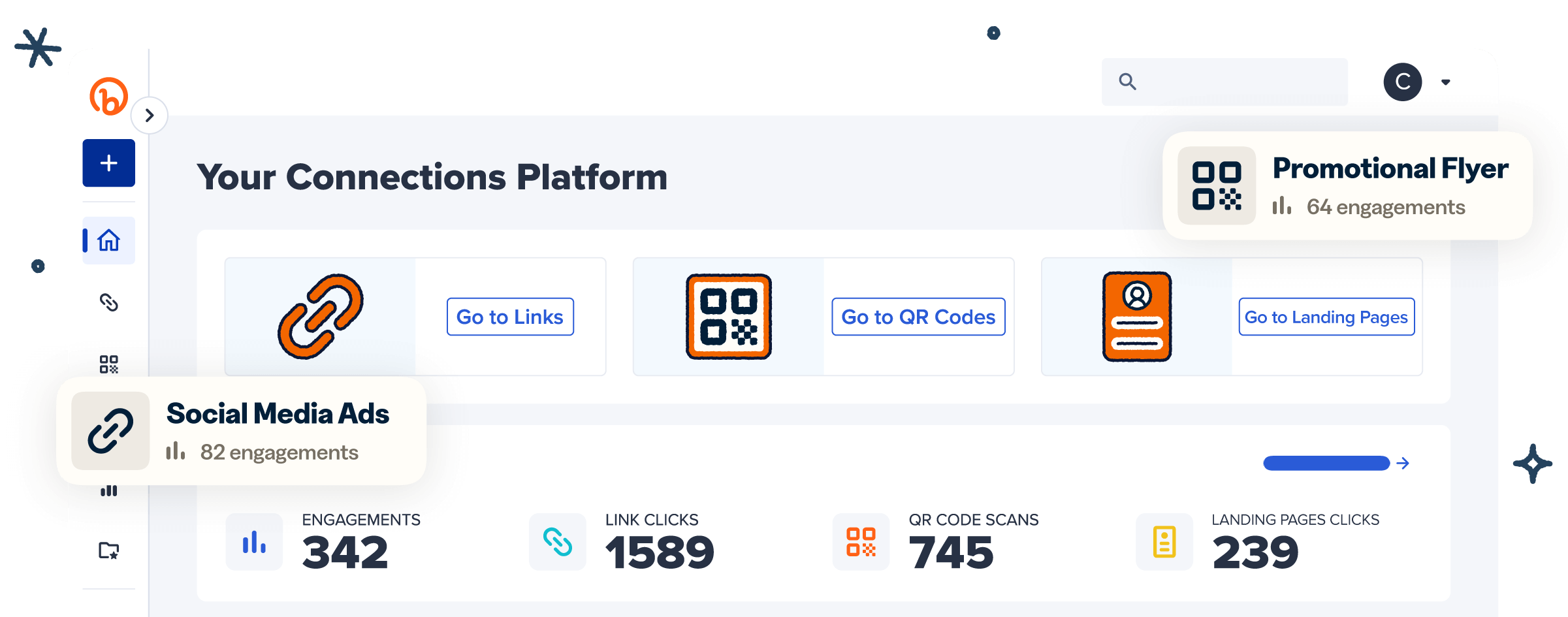

Consumers just don’t bank, spend, or invest the way they used to anymore. They’re always on the go. They jump from device to device, with the average adult being connected to more than four devices.
Over the past few years we’ve seen a rush of tech-savvy products that offer consumers greater transparency and more control. Think Betterment, Simple, and Venmo.
Traditional finance companies have followed suit, modernizing the user experience with apps, cloud servers, and automated workflows.
There’s one other traditional finance companies to gain a competitive edge in this increasingly digital landscape: the link.
Every click, swipe, and tap is a link that produces data. And each data point connects to build a larger story of how consumers are engaging across platforms, devices, and more.
“Big data has opened the window into what was once a very opaque industry. It’s allowed investment analysts to utilize business insights to facilitate trading, quickly identify risk, and ultimately help the financial markets grow,” says Steven Schwartz, President & Co-founder at Global Cyber Consultants.
Here are five ways we’ve seen finance companies use Bitly to manage the customer experience:
1) Building Personalized Banking Experiences
Financial institutions can create personalized, one-of-a-kind experiences for users using a simple Bitly link.
A lot of retail banks are now starting to use bluetooth beacons that detect when a customer is on site at a location. The beacon then pings the customer’s phone and triggers a customized message tailored just for them.
Using Bitly in tandem with this technology, you can send a trackable text when someone enters a store. This adds another layer to the consumers’ offline interaction. For example, you can send customers a welcome text that introduces the services at their local branch to help them quickly get to where they need to be. Or you can send a thank you message after a customer visits an ATM and prompt them to continue engaging with your website or app long after they leave the store.
Larger financial institutions and teams can also pair this use case with Brand Manager to get a sense of how engagement looks like across the org. Multiple teams can create user seats under one centralized Bitly account to transparently share and view data. Admins can also set permissions to ensure privacy and security.
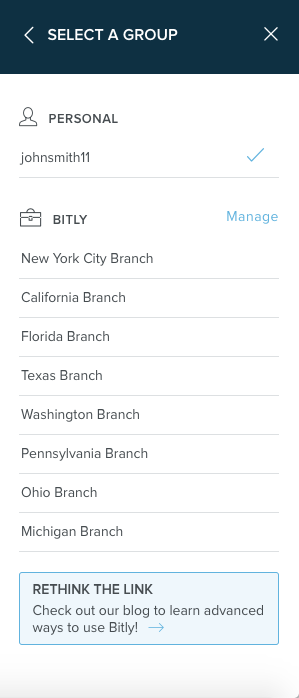
Going back to the local branch example, HQ can use Brand Manager to get a higher level view of how each branch’s clients are engaging. From there they can share learnings to help boost engagement in lower performing branches and more.
2) Helping Brokers and Financial Advisors Manage Their Content
Client-facing roles such as brokers, private bankers, and financial advisors send a lot of content on a daily basis.
Bitly links can help finance professionals stay on top of their content, measure engagement, and keep things up-to-date.
By using a Bitly link to share each piece of content, you can see which pieces are being clicked on the most and tailor their conversations according to their clients’ interests. For example, adding Bitly links to your emails can help you see if clients are clicking through and reading their contracts or invoices.
You can also use Campaigns to see a breakdown of which topics you’ve been sharing and which channels you’ve been sharing on. This can help you stay organized and quickly identify which topics have already been saturated versus which ones could use more of a push.
Last but not least, Bitly Enterprise offers link redirecting which can help you easily update content without breaking the user flow.
For example, our finance team here at Bitly has a landing page with company documents such as tax forms and articles of incorporation that they often email to clients. The documents often change each year though, so we use Bitly Enterprise to redirect the link. This helps avoid confusing and possibly frustrating customers with a new email every time we update the link.
3) Proving The ROI of Print Marketing
A recent cross-channel study showed that print marketing still brings in the highest ROI. And psychology research shows that printed materials elicit stronger emotional responses, causing consumers to spend more time with printed content than they would with digital.
That’s probably why a lot of retail banking and other customer-facing financial verticals still use print marketing pretty heavily.
Using Bitly links on printed materials can not only help you keep things branded, but it can also help you see exactly how offline marketing is affecting your bottom line.
You can track how many clients are clicking through the links on your print marketing, measure how much revenue you’re generating from these landing pages, and then compare that to your spend to get an idea of your total ROI. You can also add these links to Campaigns to compare performance across your online and offline efforts.
Bitly Enterprise can also help you reduce errors and the cost of updating printed materials. Realized there’s a typo on the brochure? Need to replace the link on your flyer? Simply go into your Bitly Enterprise dashboard, find your customized link and redirect it to your new destination.
4) Promoting Friendly Competition
Bitly Campaigns can also be used as a leaderboard to incentivize financial advisors, brokers, and other front office professionals.
Simply create a Group for each member of your team. Once a user starts generating links and sharing content with their clients, you can see how many of these clients have clicked through back in the dashboard. This creates a central internal dashboard where each team member can see how many clients are engaging with their content versus the rest of the team.
The same setup can be used to promote some friendly competition between teams. Teams managing different global markets or products can track their initiatives from the same Campaigns dashboard. Managers can add some extra incentive by throwing in a prize for the winning team who generates the most engagement.
5) Differentiate Internal vs. External Engagement of Sales Content
Bitly links can also help you identify how employees are interacting with content versus how your clients are engaging.
At Bitly, we use Campaigns to create Bitly links to keep track of internal and external engagement. For each piece of product content we produce, we create two Bitly links – one to share internally, and one for our sales team to share with clients.
This helps us get a better sense of what content pieces are most helpful for internal learning versus what topics clients are most interested in. Having this broken out in the Campaigns dashboard also helps ensure that the data is not diluted or skewed.
The Link: Small Investment, Big Gains
Knowing what your clients are interested in gives you a window into the future. It allows you to predict potential opportunities and products that clients may need.
This kind of crystal ball is what will give you an advantage when it comes to playing the market. As always in finance, the first one to secure insights on which client to pursue or which market to invest in is most likely the one to seal the deal.
By just investing a few extra seconds to create a Bitly link, you can save a wealth of time on tracking engagement, organizing content, and sharing insights.