
Imagine a marketer juggling five dashboards and still unable to answer a simple question: Which campaigns actually drove the most intent last quarter?
If you’re trying to measure both online and offline campaigns, that scenario probably feels familiar. It’s relatively easy to track a paid ad click. It’s much harder to understand how a billboard, product package, or live event influenced customer behavior later on.
Customer engagement analytics should help connect those dots. Too often, though, it becomes a collection of disconnected channel metrics instead of a true measurement framework.
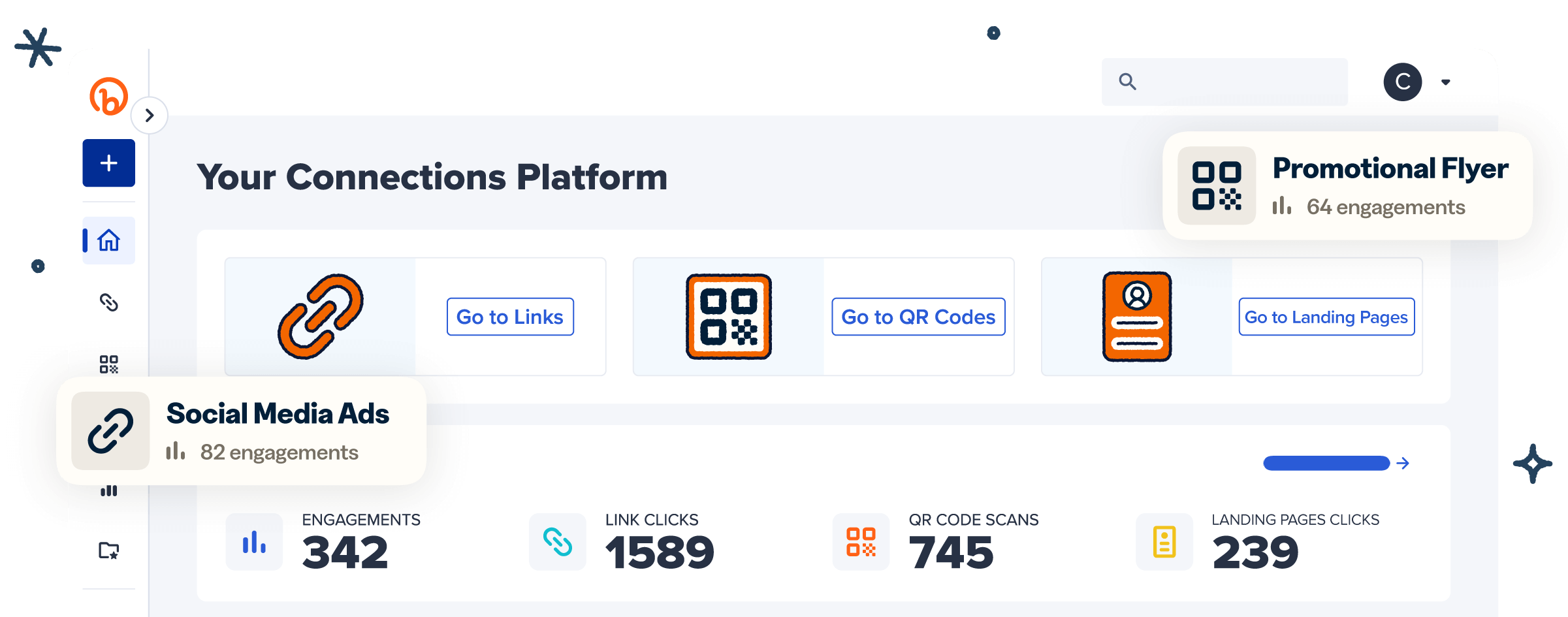
Bitly operates where offline and online engagement meet: the link and the QR Code. By capturing clicks and scans before a visitor reaches a destination page, Bitly Analytics can help teams better understand how customers move across physical and digital touchpoints.
Note: The brands and examples discussed below were found during our online research for this article.
Key takeaways
- Customer engagement analytics works best when teams measure intent signals, like clicks and scans, instead of relying only on disconnected exposure metrics.
- If your data lives in separate channel dashboards, customer engagement analytics may show activity without revealing which campaigns actually drove action.
- The biggest customer engagement analytics gaps often appear when someone moves from a physical touchpoint, like packaging or signage, into a digital journey.
- A unified view of links, QR Codes, pages, and campaigns can help teams connect engagement across channels instead of piecing together isolated events.
- For teams evaluating analytics infrastructure, customer engagement analytics should support clearer attribution, faster optimization, and a more reliable view of cross-channel performance.
The fragmentation problem hiding in your engagement data
Engagement data is scattered across social, email, web analytics, and print reporting, turning simple performance questions into expensive scavenger hunts.
Your social team measures engagement rate, your email team measures click-through rate, and your field marketing team measures foot traffic. Each metric is accurate within its own silo, but the data stays isolated. This makes cross-channel marketing and campaign tracking unnecessarily complicated.
Fragmented dashboards create false confidence because teams end up comparing unlike metrics and calling it a complete picture. A campaign might generate strong email clicks, modest social engagement, and unmeasured in-store activity, and the marketing team has to guess which channel actually moved the needle.
This isn’t a niche problem, either. Seventy-six percent of brands struggle to activate offline data for cross-channel marketing outside of ecommerce. Some brands think the problem is a lack of data, but that’s actually not the case. The real issue is that disconnected data tells disconnected stories.
What customer engagement analytics actually measures
Customer engagement should measure the moment someone moves from passive exposure to intentional action. That means looking beyond default channel metrics and focusing on the signals that show real momentum.
A useful engagement analytics framework connects metrics across links, QR Codes, landing pages, and campaigns, helping teams understand intent before conversion ever happens.
Most engagement reporting focuses almost entirely on digital interactions, even though customer journeys rarely stay confined to a single channel. A stronger cross-channel approach also accounts for physical-to-digital moments, like someone scanning a code on packaging, signage, or direct mail before visiting your site.
Exposure metrics vs. intent signals
Not all engagement data carries the same weight. Impressions tell you something was displayed, while views, time-on-page metrics, likes, and shares suggest someone briefly interacted with it. They’re useful signals, but none of them confirm that a person decided to go further.
Link clicks and QR Code scans are different. They show an active choice to leave one context and enter another. That distinction matters when you’re measuring content performance across channels, because it separates the metrics that describe reach from the metrics that reveal intent.
Why the click and the scan are your most honest data points
A click or scan is a micro-conversion. It’s the moment someone raises their hand and asks for more. Unlike a passive impression or autoplay view count, it requires deliberate action.
Someone saw your call to action (CTA), considered it, and chose to engage.
This upstream signal gives a different vantage point than page-based analytics, which only start measuring after arrival. By the time a visitor lands on your site, you’ve already lost some of the context around where they came from and what prompted them to act. Capturing intent at the link or code level gives platforms like Bitly visibility into the decision itself, not just the destination.
Where the offline-to-online tracking gap breaks your attribution chain
Offline interactions can be overlooked entirely in attribution models, even when they play a meaningful role in the customer journey.
A customer scans your product packaging or a billboard, reaches your site, and your downstream tools often classify that visit as unknown or direct traffic. The intent was real, the action was measurable, but the connection between the physical moment and the digital session got lost in transit.
Offline-to-online engagement tracking breaks down without a clear bridge, which is why attribution gaps often appear at the exact moment intent surfaces.
Without a consistent way to connect physical touchpoints to digital engagement, teams are left with incomplete reporting and fragmented attribution. That fragmentation also creates operational challenges beyond measurement. Many marketers are still struggling to make tech stack convergence happen, making cross-channel reporting and AI-driven analysis harder to scale effectively.
What downstream analytics platforms miss before the landing page
Think of most analytics platforms as starting the stopwatch at the finish line. They measure what happens after someone reaches your landing page, including page activity, navigation behavior, and downstream engagement. But they have limited visibility into what happened before arrival.
That’s the upstream gap.
Cross-channel attribution depends on consistent tracking structures across systems. If a QR Code scan from a direct mail piece and a link click from an email campaign aren’t connected through shared tracking conventions, your analytics platform has no reliable way to tie those touchpoints back to the same campaign journey. Over time, even small inconsistencies can weaken attribution accuracy across channels.
The invisible touchpoint: Physical interactions that never reach your dashboard
Some customer interactions play an important role in the buyer’s journey but never make it into reporting dashboards.
For example, a customer picks up your product in a store, notices the packaging, and wants to learn more. Without a trackable QR Code or short link on that package, the interaction disappears entirely from your reporting. The same is true for direct mail pieces, event signage, and in-store displays.
This measurement gap directly affects budget decisions. If physical activations stay invisible, you can’t fairly compare their impact to email, paid social, or influencer campaigns.
The channels you can measure will almost always appear more effective than the ones you can’t, regardless of actual performance. Over time, that imbalance can distort your entire media mix.
What unified engagement analytics looks like in practice
Unified engagement analytics lets teams compare cross-channel intent signals without stitching together data from multiple dashboards.
Bitly Links, Bitly Codes, Bitly Pages, and Bitly Analytics support this approach by creating a connected measurement layer across physical and digital touchpoints.
One campaign, three channels, one view
Consider a multi-channel product launch that includes:
- A billboard QR Code in a high-traffic metro area
- An Instagram bio link driving followers to a landing page
- An email CTA sent to your subscriber list
All three point to the same destination, but without unified tracking, each channel lives in a separate report with different metrics and limited shared context.
With Bitly Analytics, teams can compare scans and clicks from all three channels in a single campaign dashboard, identify which channel generated the strongest engagement and when activity peaked, and spot geographic patterns tied to campaign performance.
That level of visibility matters for attribution, optimization, and stakeholder reporting because it brings campaign and content analytics into a more connected view of performance.
A diagnostic framework for finding your measurement gaps
It’s gut-check time. If you can’t name your top intent-driving campaign from last quarter, your measurement system likely needs work.
Before evaluating new tools or platforms, it’s worth examining whether your current approach accounts for the customer engagement trends and best practices shaping how people interact with brands today.
- Can I see engagement signals across online and offline channels in one place? If not, you’re likely making budget and optimization decisions based on an incomplete picture, because the channels you can’t measure will almost always lose to the ones you can.
- Can I connect physical touchpoints, like mailers or in-store activations, to digital traffic and downstream engagement? A “no” here means your offline investments are effectively invisible in reporting, making it difficult to compare them fairly against digital channels.
- Am I tracking links and codes consistently to support cross-channel and cross-device attribution? Inconsistent tracking creates gaps in your attribution chain. If UTM parameters, link structures, or QR Code setups vary across teams, your data will fragment before it ever reaches a dashboard.
- Can I get timely answers about campaign performance, or do I spend days wrangling data? Speed matters. If pulling a cross-channel performance report takes days of manual work, you’re optimizing on stale information and missing opportunities to reallocate spend.
- Does my analytics stack meet enterprise requirements like Single Sign-On (SSO), custom reporting, and API access? For larger teams, security and scalability aren’t optional. If your measurement tools can’t support role-based access, custom views, or integration with your existing tech stack, adoption often slows as your organization grows.
If you answered “no” to more than one of those questions, the issue likely isn’t a single missing tool. More often, it points to a structural gap in how your measurement infrastructure connects intent signals across channels.
Stop measuring engagement in silos and start seeing the full picture with Bitly
Customer engagement analytics becomes far more useful when it accounts for the full customer journey instead of isolated channel activity. Clicks and scans are some of the clearest signals of intent because they capture the moment someone actively chooses to engage, whether that interaction starts online or in the physical world.
Bitly helps teams bring those touchpoints into a more connected measurement approach. By bringing offline and online engagement into the same reporting layer, Bitly Analytics can help reduce attribution gaps, improve cross-channel visibility, and support faster, more confident decision-making.
Ready to build a more connected view of customer engagement? Explore Bitly plans and start measuring the signals that matter most.
FAQs
What is customer engagement analytics?
Customer engagement analytics tracks how people move from exposure to action across links, QR Codes, landing pages, and campaigns. The most useful view isn’t a pile of likes or impressions. It’s a shared record of clicks and scans that shows active intent.
How do you measure customer engagement across multiple channels?
Start with consistent tracking on every entry point, then compare clicks, scans, and page activity in one dashboard. Bitly Analytics may help because it measures Bitly Links, Bitly Codes, and Bitly Pages together, making it easier to spot drop-offs and engagement patterns across channels.
What is the difference between engagement metrics and outcome metrics?
Engagement metrics show whether someone interacted, while outcome metrics show whether that interaction led to pipeline, revenue, retention, or another business result. In customer engagement analytics, clicks and scans often act as the bridge because they connect attention to the next measurable step.
Can engagement analytics connect offline and online?
Yes, if you use trackable bridges like short links and QR Codes that carry customers from a physical touchpoint to a digital destination. When scans and clicks live in the same system, teams can follow one engagement path instead of stitching together disconnected channel reports.
What should you look for in a customer engagement analytics platform?
Look for upstream tracking, clean campaign governance, privacy controls, and connected reporting across digital and physical touchpoints. For larger teams, Bitly Analytics also supports enterprise features like SSO, custom dashboards, and API access, which may simplify measurement at scale.