Luxury shoppers expect every interaction to feel intentional. From personalized invitations to carefully timed follow-ups, every detail shapes the high-end experience. But even brands with sophisticated customer engagement strategies can still miss measurable moments before, during, and after an in-store visit.
That’s why QR Codes and branded short links are being reconsidered in luxury retail. Instead of feeling overly promotional, they can serve as discreet digital touchpoints that support a polished customer journey. A subtle code at a private event or a branded link tied to a collection launch, for example, can extend exclusivity while quietly capturing engagement signals.
For marketing teams, the value is often practical. Tools like Bitly Codes, Bitly Links, and Bitly Analytics can help teams better understand how customers interact across channels without requiring a complete infrastructure overhaul.
Below, we’ll explore where those tools may fit into your existing strategy and how they can help close engagement gaps while preserving the elevated service luxury audiences expect.
Note: The brands and examples discussed below were found during our online research for this article.
Key takeaways
- Luxury retail engagement challenges often begin before the store visit, when disconnected channels fail to build the personalized anticipation high-value shoppers expect.
- In-store gaps grow when high-end retail moments generate no measurable digital signal, leaving marketers without clear visibility into customer interest or intent.
- Branded QR Codes and short links can help luxury brands extend white-glove service across packaging, signage, events, email, and follow-up communications.
- Bitly Analytics can help connect scan and click behavior across pre-visit, in-store, and post-visit touchpoints, giving teams a more unified view of customer activity across channels.
- Post-visit engagement may be one of the most overlooked luxury retail challenges because inconsistent follow-up can weaken loyalty, clienteling efforts, and long-term customer lifetime value.
Why luxury retail’s engagement crisis runs deeper than pricing
Luxury brands are facing growing pressure to justify premium pricing through experience, not exclusivity alone. Price increases across the luxury sector are expected to continue, but many brands are also facing a growing desire deficit where customer excitement becomes harder to sustain across channels.
You can see it in the way shoppers interact with campaigns. A launch may perform well on social media, but momentum fades between mobile browsing, appointment scheduling, and the actual store visit. That disconnect creates omnichannel fragmentation, where engagement feels inconsistent instead of seamless.
As luxury prices rise, shoppers are becoming more selective about the value attached to a purchase. Products may still attract attention, but the overall experience can start to feel less exclusive, personalized, or rooted in craftsmanship as the price suggests.
For marketers, that creates a difficult challenge: maintaining emotional connection while understanding where customer interest starts to drop off.
The desire deficit: When price outpaces perceived value
A shopper clicks through a luxury campaign, revisits the same product page several times, and even signs up for early access to a collection launch. But when the latest price increase hits, the purchase stalls.
That pattern is becoming more common across luxury retail, especially among aspirational shoppers. Interest may still be high, but attention alone is no longer enough to move customers from browsing to buying. Products continue generating visibility, while hesitation grows closer to the point of purchase.
Parts of the luxury market are already showing signs of slowing demand. In many cases, the challenge is strain across the purchase journey, not a complete loss of interest. Momentum fades between discovery, consideration, and conversion.
That makes engagement quality one of the few levers brands can still actively improve.
How omnichannel fragmentation breaks the white-glove promise
A client walks into a luxury store after browsing online, expecting a unique experience. The advisor greets them, but the conversation starts from scratch. Saved items, campaign clicks, and prior interactions never surface in the moment.
This omnichannel fragmentation quietly breaks the white-glove promise. In luxury retail, client advisors, ecommerce platforms, and other digital platforms hold different pieces of the customer story without a shared real-time view.
You end up with strong individual touchpoints, but inconsistent continuity between them. Inventory may appear online but not reflect what’s available in-store. Service history might live in one platform, while marketing engagement sits in another. Even when each system performs well independently, the lack of alignment creates a disconnect customers can feel.
The three-phase engagement gap luxury brands struggle to close
Luxury engagement tends to break across three moments that often live in separate systems: before a client visits a store, during the in-store experience, and after they leave. Below, we’ll explore where disconnects typically emerge across each phase and how brands can start closing those gaps throughout the luxury customer journey.
Pre-visit: Losing customers before they walk through the door
A customer taps through a lookbook, engages with a social teaser, and opens a private sale invitation—but never takes the next step toward booking an appointment or making luxury purchases. From the outside, it looks like strong interest. In practice, intent often fades before they ever reach the physical store.
This is where the pre-visit disconnect starts to emerge. Luxury brands can create compelling inspiration moments, but it’s difficult to connect those signals back to actual store traffic. You’re left with visibility into engagement, but not clarity around what’s driving action.
The real question becomes: what’s actually moving customers from interest to intent?
Branded short links in email, direct mail, and paid social can help answer that question by showing which touchpoints lead to store visits, without changing the personalized experience you’ve already designed.
During the visit: In-store moments that generate no measurable signal
A client tries on a luxury fashion piece, pauses in front of a mirror, and lingers near a display. These are often some of the most valuable interactions in retail, but they rarely show up anywhere in your data.
That’s the during-visit blind spot. In-store experiences such as product cards, packaging details, and fitting-room interactions generate real curiosity. But unless a purchase follows or a conversation happens with staff, there’s no digital signal connecting that activity back to intent.
How do you capture interest in the moment without disrupting the experience?
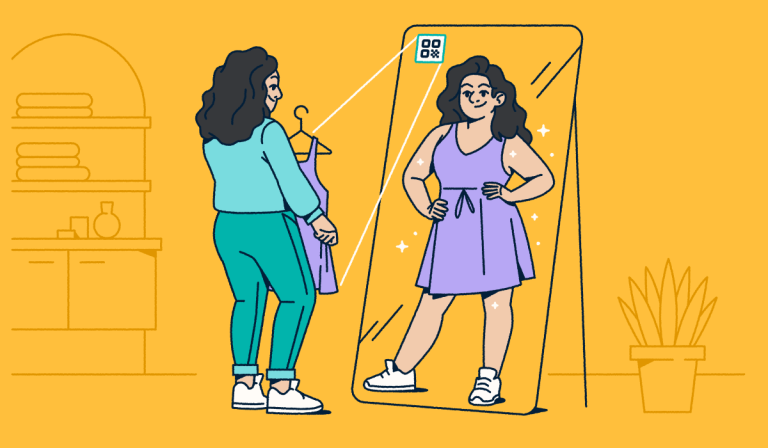
Bitly Codes can add a quiet digital layer to those interactions. They might link to styling details or size availability from a product display or offer product care guidance through a care card. In fitting rooms, they can sit subtly on mirrors or signage, giving shoppers a way to save or revisit items they’re considering.
Rather than relying on staff capture or missed observations, customers can explore further in real time while teams measure in-store customer engagement with QR Codes.
Post-visit: The loyalty window most brands leave wide open
A client leaves the store with their luxury goods, and the relationship often ends there—at least from a tracking perspective. The interaction may have felt personal in-store, but the follow-through is usually invisible.
This is the post-visit gap. You might send a thank-you note, share care instructions, or follow up with an appointment recap, but it’s difficult to see what keeps a customer engaged afterward. Did they revisit the collection? Explore similar pieces? Consider a second purchase? Most of those signals disappear once the receipt is delivered.
The bigger question is what drives retention after checkout.
Trackable short links help extend engagement beyond the purchase. Including them in thank-you notes or follow-up emails can bring customers back to the collection they purchased from. In care guides, they can connect shoppers to how-to support or service options, turning routine aftercare into something more useful.
Placed in repair content, these links can streamline access to bookings or support, while post-visit recaps can reconnect customers with items they viewed, saved, or tried on to help maintain interest after the purchase.
Why traditional engagement tools fall short in luxury contexts
Luxury teams don’t usually push back on engagement tools because they lack capability. Instead, the hesitation often comes from what those tools prioritize.
Many traditional retail platforms are designed to maximize speed and conversion volume. Pop-ups appear quickly, follow-ups feel automated, and customer journeys get reduced to attribution metrics. In a luxury setting, that friction becomes noticeable fast because the experience needs to feel personal and grounded in human connection, not heavily optimized.
That disconnect matters even more as the luxury rebound becomes less predictable. Recent reporting points to an uneven recovery across the luxury industry, adding pressure on brands to protect both demand and perception.
When growth becomes less reliable, engagement tools have to do more than report transactions. They also need to help teams understand customer interest without making interactions feel generic or overly engineered around the sale.
The brand aesthetics problem with generic tracking tools
One of the biggest objections to QR Codes in luxury retail rarely gets said out loud: many of them simply look cheap.
A generic black-and-white code placed beside premium packaging or inside a luxury store can feel out of place immediately. The same goes for generic short links that don’t reflect the brand at all. Even when the tracking works, the digital touchpoint can still feel disconnected from everything around it.
Visual control over logos, colors, patterns, and custom domains shapes whether QR Codes or short links appear intentional or added at the last minute. In luxury retail, those elements are part of the experience, not decoration.
When evaluating engagement tools, brands still need the tracking layer to feel polished and consistent with the broader customer journey.
Data silos that prevent unified customer profiles
A customer interacts with a luxury brand in more places than most systems can keep up with. They might engage with a campaign, attend a launch event, message an advisor, and later make a purchase. But those interactions rarely connect behind the scenes.
What a team sees depends on where they’re looking, not the full customer picture. That disconnect shows up quickly in clienteling. Follow-ups lose context, outreach feels delayed, and teams miss signals that could have shaped a more relevant conversation.
Luxury retail is moving toward more connected store experiences, where digital and physical interactions support each other instead of operating independently. That only works when customer insight moves across channels as smoothly as the shopping experience itself.
The measurement gap between in-store behavior and digital outcomes
A customer might spend time in a fitting room or ask questions in-store. Those interactions often matter most in the decision-making process, but they rarely show up anywhere once the visit ends.
That’s the measurement gap: customer engagement is happening, but it becomes invisible once it happens offline. A shopper who returns days later to book an appointment or complete a purchase may have been influenced by something that never made it into your reporting.
It’s a different picture from digital channels, where every click and interaction is automatically captured. That contrast makes it harder for luxury teams to connect intent across the customer journey.
Bridgeable touchpoints, such as QR Codes in-store, links in follow-up emails, and product cards, help close this gap by giving in-store interactions a way to continue into the digital path that follows.
How QR Codes and short links bridge the physical-digital divide
QR Codes and short links offer simple ways to keep the conversation going after a customer leaves the store. That flexibility matters in fragmented environments, where teams can’t wait for a full systems overhaul to start connecting the dots.
Below, we’ll look at how branded QR Codes, short links, and scan and click data help connect in-store interactions with digital experiences across everyday luxury touchpoints, making customer behavior easier to understand.
Branded QR Codes as luxury touchpoints, not just tracking tools
A client pauses at a mirror in a luxury store or picks up a product card tucked beside a display. Curiosity is already there, but the question is whether there’s an easy, comfortable next step.
Branded QR Codes work best when they feel fully integrated into the experience. When placed on mirrors, product cards, or packaging inserts, custom colors, logos, and design elements help them feel intentional—more like an invitation than a prompt to scan.
That’s part of how luxury retail can use QR Codes without disrupting the atmosphere brands work hard to create. In private appointments or VIP events, attention is high, but expectations around discretion are just as strong. What happens after the scan should match that tone. Rather than pushing directly to purchase, the destination might lead to a collection story, care content, waitlist, or appointment booking page.
These branded QR Codes keep interactions useful for customers while giving teams a clearer signal of intent.
Short links that extend the in-store experience into digital channels
Luxury retail conversations often continue after checkout through follow-up emails, client advisor messages, or a carefully timed SMS after a visit. But the link is often where the continuity either holds together or starts to break down.
Bitly Links help carry those interactions into digital channels without disrupting brand identity. A short, custom-domain link with a clean slug feels more refined than a generic URL. Luxury customers notice that level of polish, even in something as small as a link.
In lookbooks or packaging inserts, for example, a short link can guide a customer back to a specific collection or appointment page, creating hybrid retail experiences that feel like a continuation, not a redirect.
Building the clienteling intelligence loop with scan and click data
Connecting scan and click behavior over time can give clienteling teams a clearer view of customer interest. A QR Code interaction from packaging or engagement with a follow-up link after a store visit may seem small on its own, but together those signals begin generating customer data around what shoppers are actually interested in.
Bitly Analytics helps surface the patterns behind that activity. Teams can see what content gets revisited, which follow-ups drive engagement, and when interest starts building again after a visit.
Clienteling teams can use that context to shape outreach that feels more relevant and better timed. A follow-up can reflect what a customer explored instead of relying on broad assumptions. Even without a fully unified customer relationship management (CRM) environment, these engagement signals can help make outreach more informed and easier to personalize.
Turning engagement data into white-glove service at scale
Luxury teams are short on usable signals, not engagement data. The challenge now is turning scattered interactions into decisions that improve how service shows up across the customer journey.
Analytics works best when it connects activity across channels instead of sitting on the sidelines as reporting. What matters most is what helps teams respond faster and more precisely: when interest peaks, where it appears, which assets get revisited, and how event engagement unfolds.
As digital shopping habits raise expectations for relevance and speed, luxury consumers expect the same from their experiences. Generic outreach gets noticed faster, while delayed follow-ups stand out sooner.
Below, we’ll look at how engagement signals surface across reporting, in-store activity, and events—and what those insights make easier for teams to act on.
What Bitly Analytics reveals across the pre, during, and post journey
A customer clicks a collection link before visiting a store, scans a QR Code during an appointment, then opens a follow-up message a few days later. The problem is those actions often get reviewed in completely different places.
Marketing sees campaign clicks, while store teams see scans. Clienteling teams track follow-up engagement. By the time someone pieces those signals together, the opportunity to act may already be gone.
Bitly Analytics makes it easier to compare those touchpoints in one view. Pre-visit clicks can reveal early interest, while in-store scans show what captured attention during an appointment. Post-visit engagement can help identify which customers continue interacting afterward.
That shared visibility helps prevent fragmented reporting from slowing decisions, especially when luxury campaigns move across physical and digital channels simultaneously.
Using scan geography and timing data to improve the in-store experience
Two displays can sit a few feet apart and generate entirely different levels of engagement. One consistently gets scanned, while the other becomes a dead zone customers walk past. Without scan data, both may appear equally effective from a distance.
Timing tells a similar story. Some appointment windows naturally drive more interaction, while certain follow-up periods see stronger response rates than others. Certain markets may engage more with specific luxury product collections, giving teams a clear signal about what deserves more visibility locally.
That kind of visibility becomes more valuable when teams use it to make real adjustments. A low-performing display may need to move locations. Staffing might need to shift toward higher-engagement time windows, while outreach can be retimed around when customers are more responsive instead of when campaigns were originally scheduled.
Over time, these patterns make it easier to refine the in-store experience using real customer behavior instead of assumptions.
Event-based engagement: Measuring private reviews and VIP moments
A luxury event can generate strong engagement long before guests arrive. Someone revisits a private preview invitation before RSVPing. A trunk show follow-up gets revisited days later. A QR Code at an exclusive event, like a VIP dinner, draws more attention to one collection than another.
Those signals are easy to miss when performance gets reduced to attendance alone.
Bitly tracking helps teams follow engagement across the full event experience, from invitation links and reminder messages to in-person scans and post-event follow-up. That creates a clearer view of which interactions sustained interest after the event.
As luxury brands place more emphasis on experiential retail alongside digital engagement, measuring those interactions becomes even more important. Events influence future appointments, continued browsing, and deeper customer relationships long after the evening is over.
Engagement quality is the lever luxury brands can actually pull right now
Luxury brands have less room to rely on price increases alone. What’s more actionable right now is improving how connected the customer experience feels across digital and in-store touchpoints. The brands that respond faster, personalize more effectively, and reduce friction across the journey are often the ones that sustain customer loyalty long after the initial interaction.
Bitly helps luxury retail teams create more connected experiences through branded links, QR Codes, and trackable touchpoints that work across physical and digital channels. Better visibility into what customers revisit, engage with, and respond to can help teams deliver more timely outreach without disrupting the elevated experience luxury audiences expect.
Explore Bitly’s pricing and plans to see how branded QR Codes, short links, and analytics can support more connected luxury engagement.
FAQs
Why is customer engagement so difficult for luxury retail brands today?
Luxury shoppers expect white-glove service across every touchpoint, but many brands still operate fragmented store, ecommerce, and clienteling systems. That gap can make personalization feel inconsistent and turn valuable in-store interactions into signals your team cannot easily measure or act on.
How can luxury brands maintain exclusivity while expanding digital engagement?
Digital engagement doesn’t have to feel mass market if the experience stays branded, curated, and invitation-led. Branded QR Codes, custom short links, and gated destinations can help luxury teams extend access without giving up aesthetic control or measurable insight.
What role do QR Codes play in luxury retail engagement?
QR Codes can turn packaging, displays, event materials, and receipts into elegant bridges between physical service and digital follow-through. When those scans are branded and trackable in Bitly, teams can better understand which touchpoints spark interest before, during, and after visits.
How do short links improve the luxury customer journey before and after a store visit?
Before a visit, short links make concierge emails, lookbooks, and appointment reminders easier to share, scan, and trust across channels. Afterward, they can carry customers to care guides, private event invites, or tailored follow-up pages while preserving campaign-level measurement.
What should luxury marketers measure across pre-visit, in-store, and post-visit engagement?
Focus on which messages drive appointments, which in-store assets generate scans, and which follow-up links keep customers engaged after a visit. Bitly Analytics may help unify clicks, scans, timing, geography, and page engagement so teams can adjust staffing, content, and outreach with more confidence. That visibility helps move clienteling strategies beyond educated guesses and toward more informed, responsive engagement over time.
More Articles
More than a link shortener
Knowing how your clicks and scans are performing should be as easy as making them. Track, analyze, and optimize all your connections in one place.