
Now’s a good time to be in eCommerce – growth is to up and to the right.
Sales are predicted to grow to more than $400 billion by 2018, according to research by Forrester and eMarketer. The majority of U.S., 80% of consumers, has shopped online in the past year.
But as the market grows, eCommerce companies also have the difficult job of cutting through the highly competitive environment. Ecommerce businesses report that their biggest challenges include personalization, building a consistent customer experience and integrating cross-channel insights.
Luckily, all of these points can be tied back to one source: the link.
At Bitly, we’ve seen eCommerce companies of all sizes and industries use the link to build, manage, and personalize the customer experience.
With a little help from Senior Customer Success Manager, Caitlin Rashbaum, we’ve rounded up ten ways eCommerce companies use Bitly across the customer journey:
1) Cross-Channel Branding
With 90% of U.S. households owning three or more devices and the average person using more than five social media accounts, consumers are more vocal than ever. It can be challenging for marketers to manage the volume of inbound feedback, much less manage brand perception.
At Bitly, we’ve seen brands use custom branded domains and the customized back-half of the link to build the brand across different channels. A custom branded domain adds a layer of authority and, thanks to auto-branding, keeps the branding consistent when followers share your content with their network, friends, and family.
Here’s an example of how our own marketing team uses Bitly to do this:
2) Consistent User-Experience
On average, it takes 7 to 13 touches before a customer buys. There’s no linear customer journey to product pages. That makes it a challenge for eCommerce businesses to build a consistent shopping experience across channels and devices.
It’s worth it, though. Multi-channel customers spend three to four times more than single-channel customers.
So how does Bitly help? One major department store uses Bitly’s API and an SMS service to bridge the in-store and online experience.
When a customer reaches a brick-and-mortar location, the app detects their location. It then sends a text message with a custom Bitly link driving back to a landing page with personalized content based on their purchase history, app search history, and saved items.
3) One-to-One Communication
Research shows that 94% of marketers believe personalization is key to future success. If that’s the case, brands have a long way to go. Almost half of all consumers (40%) say that promotions don’t deliver anything of interest.
One of the biggest hurdles to true personalization is data.
With Bitly, eCommerce companies collect quick, real-time insights on all of their channels in one dashboard. They’re able to see which cities consumers are engaging from, which consumers are most engaged, which products they’re responding to, and more.
4) Paid Social
Social becoming more pay to play, and the prices for paid ads are rising too. Facebook’s advertising now accounts for 70% of its valuation. To squeeze the most out of every dollar, you have to A/B test to find the best content and call-to-action for your budget.
Social Quant, a tech company for Twitter growth, uses Bitly links to optimize paid social campaigns:
5) Visual Content
Visual-first social media platforms like Instagram and Snapchat, despite their popularity, are still tricky channels for marketers to measure.
On the surface, it looks like a lot of the data is untraceable. On Instagram, the only place you can put a clickable link is in the bio. On Snapchat, the content disappears.
KIND Snacks and Mashable work around this by using Bitly links to track engagement:
6) Dumping the Spreadsheet
Marketers spend an average of three and a half hours per week collecting, organizing and analyzing data. Using Bitly Campaigns, eCommerce surf shop, Vissla, saves about 185 hours a year.
With Campaigns, Vissla was also able to see that Instagram Ads delivered 30% more clicks than an email marketing campaign about the same products.
Here’s a little peek at what the dashboard looks like:
7) Influencer Partnerships
Recently, a social media exec shared with online publication Digiday that they spent too much money on influencers. Influencer marketing can give your brand an immediate boost in engagement and reach, but it’s harder to track exactly what it does for your bottom line. Do likes and retweets actually generate revenue?
We’ve seen brands give influencers a customized Bitly link to share in their social promotions, so that it’s easy to track exactly how much influencers drive back to product pages, landing pages, and other content.
8) Product Performance
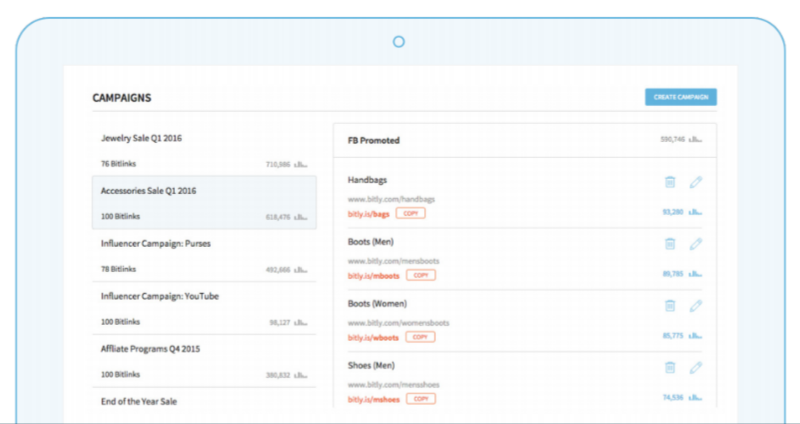
Ecommerce companies can also use Bitly Campaigns to slice and dice engagement by product type or persona.
These insights can power your marketing teams’ personalization efforts and help your merchandising and buying teams make more informed decisions when planning inventory for future seasons.
9) To Track Regional Sales
Ecommerce companies can also use Campaigns to see how certain cities are engaging to create tailored, regional content.
Here’s an example of how one luxury retailer is using Bitly Campaigns to do this:
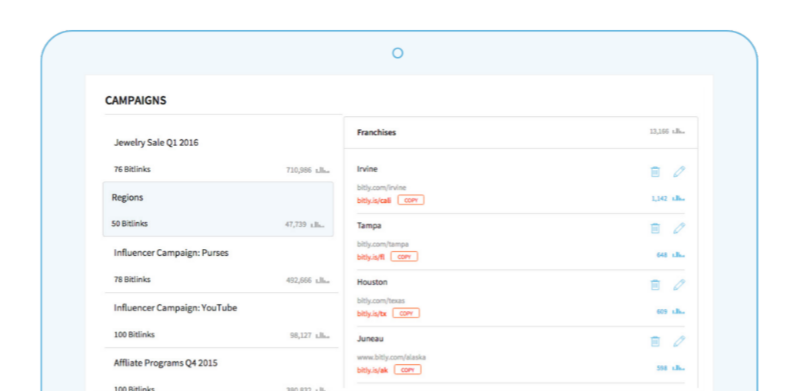
In this mockup, you can see that Irvine, California is the most engaged city since they are clicking the most on product landing pages. This might mean that the eCommerce company will want to test out a special promotion or even an in-person event in that region to boost sales.
10) Bridging Silos
Need to pull some data on how many shoppers under the age of 30 visited a specific product page? If you’re working for a larger eCommerce company, you likely have to go through IT or another team to get the information you need. It’s time consuming and it often takes a few back and forths to get the right insights.
Larger eCommerce companies often run into the challenge of exchanging data between teams, and getting visibility into how products are performing in other product lines or regions.
Publishing company, Cox Media Group (CMG), leverages Bitly Enterprise’s user seats to keep their 70+ brands on the platform organized:
Ecommerce companies can use user seats to compare brick-and-mortar promotions with online campaigns, bridge the data between merchandising, buying, and marketing teams, or to help different product lines build a cohesive marketing strategy.
Building a Central Engine
Industry reports predict that 2017 will bring even more real-time experiences, mobile shopping, and social commerce.
As the number of digital channels multiply and adapt for quicker, easier shopping, eCommerce companies will have to rely on data, more than ever, to learn how customers are engaging across the user experience.
Housing all of your data in one centralized place helps every team in the company create, build, and buy content and products that make for a seamless customer experience.