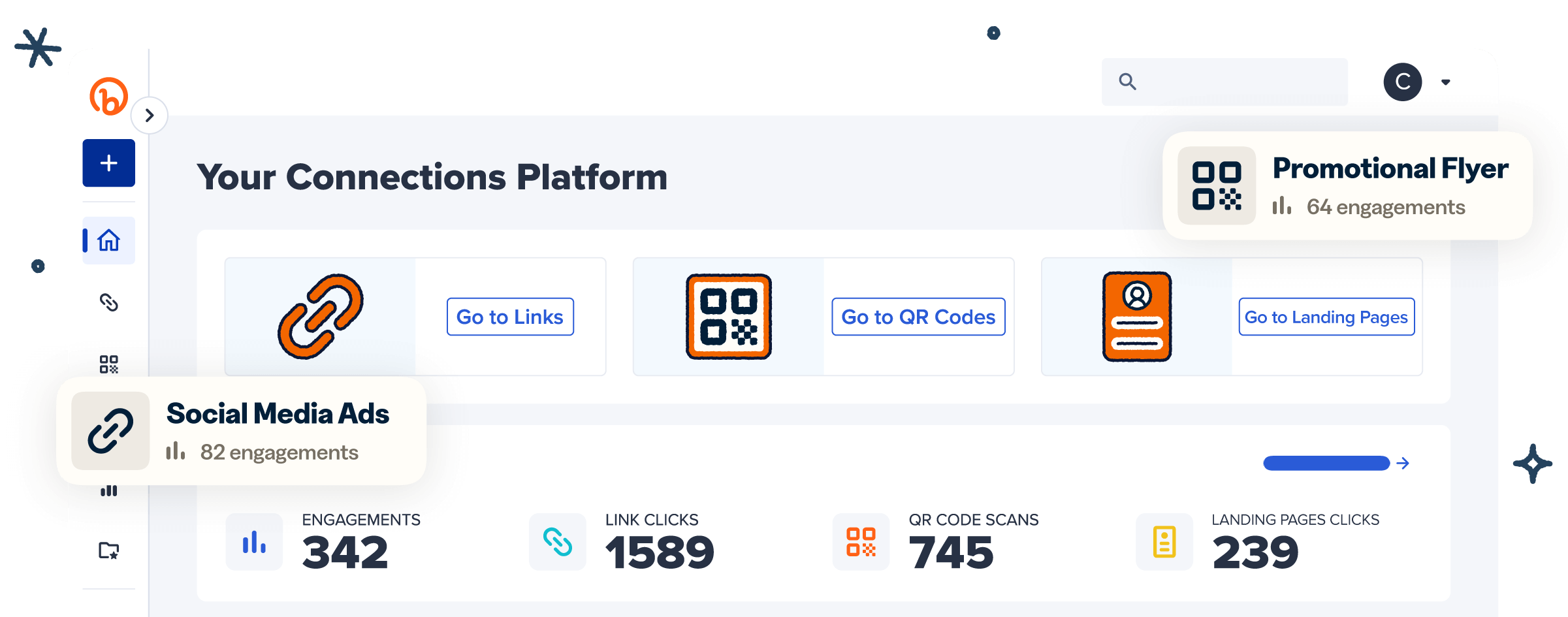

In the hunt for buyer intent, B2B marketing and sales teams are looking for any edge they can get. Salesforce Clickstream data is a game-changer for surfacing richer, more timely intent signals in the sales and marketing funnel. This real-time behavioral data gives businesses more actionable visibility into complex buyer behavior and buying signals. But what happens when that buying intent happens off your website, on social media, in an email, or via a printed QR Code?
We’ll walk you through how marketing and sales teams can integrate Bitly’s first-party click and scan data with Salesforce CRM insights. This combination deepens understanding, improves lead prioritization, enables real-time personalization, and accelerates pipeline velocity. We will explore the value of combining Bitly’s first-party touchpoint data with Salesforce’s real-time ingestion and signal processing tools.
Note: The brands and examples discussed below were found during our online research for this article.
What is Salesforce Clickstream data?
Salesforce Clickstream data is a detailed record of behavioral tracking from your websites, apps, and platforms. This intent data feeds directly into Data 360 (formerly Salesforce Data Cloud), leveraging its Real-Time Ingestion capabilities. The result is more than a user profile; it includes granular browsing activity, product page views, search terms used, content downloads, and the interaction paths a user takes, often captured in sub-second timeframes.
A common use case is seeing when a potential customer scrolls your pricing page or makes multiple visits to demo content, signaling high intent. By connecting Bitly to Salesforce for 360 customer views, you can add even more behavioral context to this profile.
Understanding intent signals in B2B sales
Intent signals are behavioral clues that indicate a prospect is in-market or interested in your solution. It is important to differentiate between first-party signals (a user’s activity on your own site, like website visits) and third-party intent data (their content consumption across the wider web). These buying signals inform lead scoring models, ABM targeting, and sales prioritization.
But not all intent signals are equal; context and frequency matter. B2B buyers now spend the vast majority of their journey researching independently. Meetings with potential suppliers represent only a small portion of the entire path to purchase. This reality makes capturing digital intent data from every touchpoint critical.
Why clickstream data improves intent accuracy
Clickstream data provides granular, continuous behavioral insights. This holistic understanding adds crucial context to the static, firmographic profiles (like company size or industry) that marketing teams often rely on. When you combine Salesforce Clickstream with Bitly click and scan data, you enrich real-time customer profiles with touchpoints from every channel, online and off.
This unified view leads to faster reactions, with trigger-based sales alerts and other features that can lead to much stronger outreach timing. This speed is essential, as more than three-quarters of buyers go with the firm that responds first.
Ways to enhance lead scoring with Bitly + Salesforce
Lead scoring is where automation really becomes powerful. Every Bitly Link click and QR Code scan is a first-party intent signal. By integrating Bitly with your existing stack, you can feed this additional behavioral data directly into your Salesforce CRM.
Sales and marketing operations teams can assign scores to specific interactions (like +10 for a pricing page click, +20 for a webinar QR Code scan). You can then layer these scores with native Salesforce signals to build richer, more accurate qualification models. A key use case is tracking campaign clicks or QR Code scans from an event and tying them directly to Salesforce leads or contacts. This approach lets you use click and scan data to enhance lead scoring with Salesforce and Bitly automatically.
Scoring high-intent actions in real time
You can assign point values to key behaviors in your scoring models. For example, a single click on a social media link might be a +5. But repeat scans of a Bitly Code on a product, or clicks on links in an email nurture sequence, should score as high-intent (+25). These points can then sync directly with Salesforce’s native lead scoring tools or custom automation workflows.
Unifying behavioral data across platforms
The goal in prospect data analysis is a single source of truth. There is immense value in combining website, email, ad, and QR Code activity into one unified Salesforce profile. Bitly and Salesforce integration, using either pre-built connectors from our marketplace or a custom solution accessing our open API, enables this type of universal oversight. Your sales team no longer has to guess what segment a prospect favors; they can see the entire history of content consumption, from the first whitepaper download to the most recent scan of a lead generation QR Code at a trade show.
Real-time personalization and sales activation
Intent signals from Clickstream and Bitly can power sales outreach automation and personalized content delivery. This setup allows your go-to-market team to optimize workflows; they can dynamically assign leads to the right sales development representative (SDR) based on their engagement score, automatically personalize follow-up emails based on their specific product interest, or trigger retargeting ads for high-value target accounts.
The right process eliminates «cold» outreach and enables just-in-time messaging that resonates because it’s relevant. This kind of sales enablement, similar to how teams connect Microsoft Power Apps to Bitly for sales enablement, ensures your team acts on intent data immediately to close deals while they are hot.
Trigger-based workflows and campaigns
You can build automations in tools like Salesforce Flow to act on real-time signals from both Bitly and Clickstream data. A powerful example: A prospect at an event scans a Bitly Code for a demo and provides their contact info. This action instantly triggers a workflow that sends a personalized follow-up email and creates a notification (or a task) for their assigned SDR in Salesforce. It all happens automatically within your own ecosystem before the prospect has even left your booth.
Dynamic content and offers based on behavior
Marketing teams can use this unified profile to change what content or offers are shown to website visitors based on their inferred intent stage. A top-of-funnel visitor who clicked one link might see a blog post. But a high-intent lead who has clicked multiple product pages can be automatically served case studies or a «Book a Demo» prompt.
Challenges to watch when interpreting intent signals
More metrics do not always lead to more clarity. You must distinguish curiosity from actual buying intent. A single PDF download (a one-time behavior) should not be over-scored for purchase intent. Always layer firmographic filters (like company size, industry, or ideal customer profile [ICP] match) with your behavioral data to prioritize the right leads from your target accounts. You also need clean data pipelines, good deduplication practices, and clear ownership of scoring models between sales and marketing.
Start using better signals to drive smarter revenue
Salesforce Clickstream data provides a foundational layer of buyer intent, but it becomes truly powerful when enriched with first-party behavioral data from all your other touchpoints. When you unify website activity with every link click, download, and QR Code scan, you dramatically improve the accuracy of your lead scoring, sharpen your intent accuracy, and perfect your sales timing.
This is where Bitly provides the critical connection. By integrating Bitly’s click and scan data directly with your Salesforce CRM, you operationalize these real-time intent signals at scale. You are feeding your scoring models with high-intent actions the moment they happen, giving your sales team the actionable insights they need to prioritize outreach and personalize messaging.
Ready to optimize your sales cycles? Sign in to Bitly now and find the right automation solution for your team today.