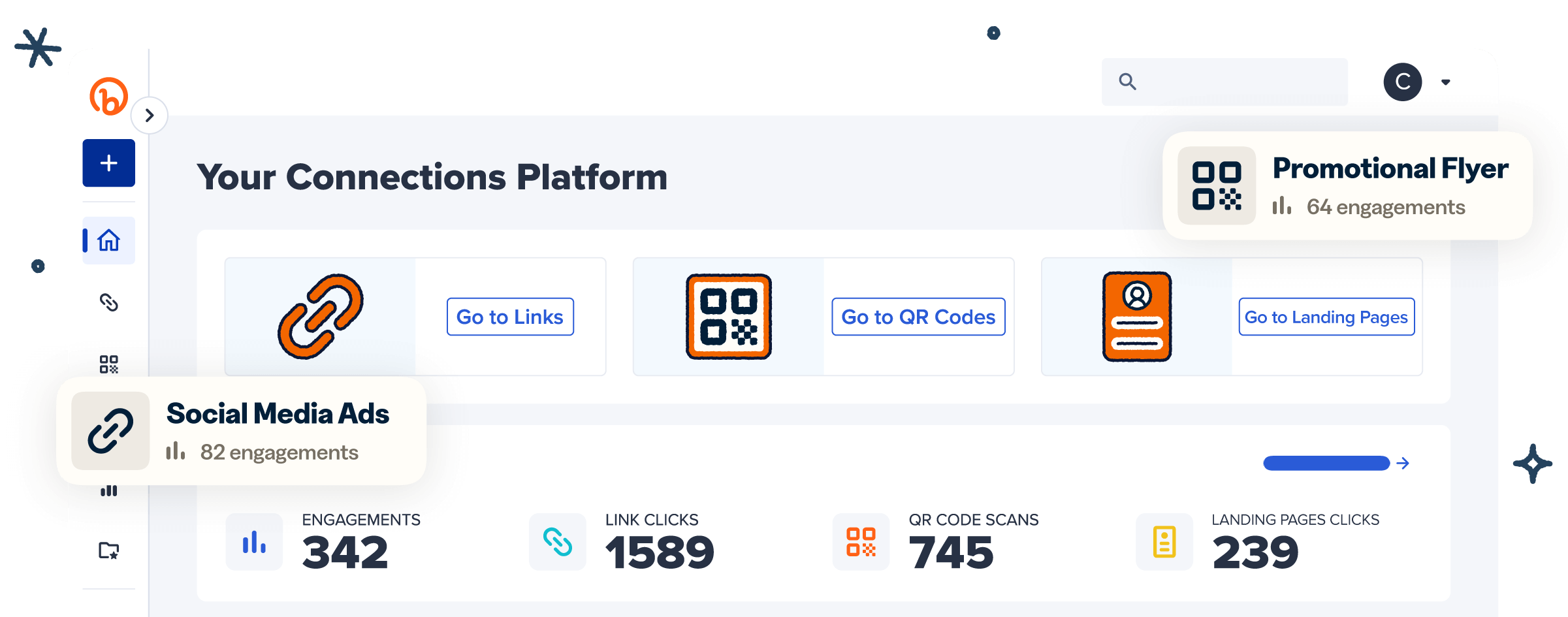

If you’re comparing Bitly and QRFY, you probably want more than a QR Code generator. You want a platform that helps you launch campaigns, manage destinations, and measure results.
Bitly and QRFY both support QR Codes, but they solve different marketing problems across various marketing campaigns. Bitly combines QR Codes, short links, landing pages, and analytics into a single workflow. QRFY keeps its focus on QR-centered creation, customization, and tracking. That split shapes reporting and pricing.
This guide compares the two platforms and explores how they handle Dynamic QR Codes, analytics, link management, bulk generation, and scale.
Note: The brands and examples discussed below were found during our online research for this article.
Key takeaways
- Bitly and QRFY are both used for QR Code generation, but Bitly extends further into link shortening, content analytics, smart links, landing pages, and broader digital campaign workflows.
- QRFY stands out for its QR-focused experience, including a wide range of QR content types, team access, bulk creation, and customization options that can appeal to businesses prioritizing QR campaigns.
- Bitly is better positioned for marketers who want one platform for Bitly Codes, Bitly Links, Bitly Pages, and centralized analytics across both scans and clicks.
- Review data suggests Bitly is especially valued for ease of use, link shortening, link management, and campaign tracking, while QRFY is often recognized for ease of use, customer support, customization, and QR-focused analytics.
- The best choice depends on whether you need a QR-first tool or a broader workflow that supports branded, trackable digital engagement across channels.
Bitly vs. QRFY at a glance
Both platforms cover the core QR use case, but they frame the job differently. Bitly acts like a broader connections platform. QRFY acts like a focused QR campaign platform.
| Category | Bitly | QRFY |
| Primary use case | Connected campaigns with QR Codes, short links, landing pages, and analytics | QR-first campaign creation and management |
| Dynamic QR Codes | Yes | Yes |
| Static QR Codes | Yes | Yes |
| URL shortening | Core platform feature | Supports short URLs for QR destinations |
| Landing pages | Yes, with Bitly Pages | Yes, through QR destinations |
| Analytics | Tracks scans, clicks, and page engagement in one system | Focuses on QR analytics and pixel-driven tracking |
| Bulk creation | Available on higher tiers | Supports bulk upload and download |
| Team access | Supports groups, roles, SSO, and Enterprise controls | Supports invited users and folder access |
| Custom domains | Available on paid plans | Supported |
| Best fit | Marketers who want one connected system | Teams that want a dedicated QR workflow |
Reviews of the platform are comparable. G2 currently shows Bitly at 4.5 out of 5 from 915 reviews and QRFY at 4.6 out of 5 from 221 reviews. G2 also places Bitly in other categories beyond QR Code Generator, including URL Shortener, Smart Link, Content Analytics, Social Media Analytics, and Landing Page Builders.
Compare QR Code creation and customization
Bitly and QRFY both make QR creation easy, but they guide users toward different outcomes.
Bitly treats QR Codes as one part of a larger campaign toolkit. You can create a code, connect it to a short link or page, and keep everything inside one platform. That structure works well for marketers who want to streamline their workflows with fewer tools and cleaner reporting. Bitly also supports logo integration, color changes, and other QR Code design controls, similar to what you might find in tools like Canva. The free plan gives users two QR Codes per month with unlimited scans from users.
QRFY places greater emphasis on QR Code creation itself. Its flow stays simple. Choose a destination, design the code, then download it. It also offers a wide range of destination types. You can build codes for websites, PDFs, menus, videos, coupons, apps, feedback flows, events, and more. QRFY also gives users strong design flexibility through templates, frames, colors, logos, and reusable styling.
In essence, QRFY pushes breadth inside the QR category. Bitly pushes integration across the wider campaign journey.
Dynamic vs. Static QR Codes in real campaigns
Dynamic QR Codes matter because they let you print a code once and retain the freedom to change the destination later. The code on your product packaging may need to point to a launch page today and to a support page next month. An event sign may point to registration first, then to a recap page after the event ends.
Both Bitly and QRFY support Dynamic QR Codes, so both platforms can handle those changes. The real difference comes after the scan. Bitly lets marketers connect that QR experience to short links, landing pages, and centralized analytics, while QRFY keeps the experience focused on the QR asset and the campaign around it.
If you want a sharper breakdown of when editability matters, our guide on Static vs Dynamic QR Codes provides useful context.
Compare analytics, tracking, and campaign visibility
Bitly gives marketers one place to track QR Code scans, short-link clicks, branded link analytics, and Bitly Page engagement. That shared view helps when your campaign spans print, email, social, product packaging, and paid media.
Higher service tiers add more depth, including city-level data, device data, campaign tracking, and expanded API access for real-time data flows. While Bitly doesn’t track conversions or form completions natively, it’s easy to integrate with CRM suites and other popular software stacks using no-code solutions from our marketplace.
QRFY takes a narrower approach, but that narrow focus can work in its favor. The platform highlights QR-specific analytics like total scans, unique scans, locations, and operating systems. It also supports integrations with Google Analytics 4, Facebook Pixel, and Google Tag Manager for retargeting or event tracking.
Do you want to understand the QR Code inside a larger campaign system, or do you want more specialized QR reporting and pixel support? That determination will help you decide which platform is right for you.
What marketers should look for in QR Code reporting
Strong QR reporting should answer a few practical questions right away: Can you clearly see the scan volume? Can you compare several codes without friction? Can you connect scans to the rest of your marketing activity?
Bitly handles those needs well when QR Codes are part of a broader customer journey. QRFY handles them well when QR Codes sit at the center of the campaign. Our examination of Bitly analytics vs native social analytics helps clarify the broader reporting question and shows how clear, precise reporting adds value to any campaign.
Compare link management, landing pages, and connected experiences
Bitly does much more than generate QR Codes; it helps you optimize your entire digital presence. It gives marketers short links, branded links, redirect controls on paid tiers, and Bitly Pages for mobile-friendly landing pages. That matters when a QR Code starts the interaction but does not complete it. Bitly makes that connected journey easier to manage because the code, the link, the page, and the reporting all live in one place.
Bitly’s free plan also includes five links per month and two landing pages, so smaller teams can test that connected model without a big commitment. Our Growth tier expands the workflow with branded links (see more about branded vs generic links), a complimentary custom domain, more landing pages, and bulk creation.
QRFY supports many destinations and can power landing-page style experiences. It also supports custom domains and template reuse. That gives marketers plenty of freedom inside the QRFY workflow. Still, the platform does not aim to deliver a full link-management system as Bitly does. It focuses more on what the QR Code can do than on how links, pages, and codes work together across channels.
When a QR Code is only one part of the customer journey
Most marketers do not run QR campaigns in isolation. A code on packaging can lead to a product guide. A flyer can drive to a signup page. A social post can reuse the same destination shared in an SMS through a short link. When those touchpoints connect, Bitly’s platform helps marketers move smoothly from step to step.
QRFY also supports strong customer journeys, especially when the QR Code acts as the main vehicle for the experience. Menus, event pages, app downloads, feedback flows, business cards, and digital contact exchanges fit that model well. The difference comes down to where QR Codes operate in your complete customer narrative.
Compare bulk generation, team workflows, and scale
Bitly supports bulk link and QR Code creation on higher paid plans, then adds more depth as plans scale. Our Growth tier unlocks bulk creation. Premium expands monthly volume and data retention. Enterprise adds clearer governance with group permissions, SSO, webhooks, and admin controls that larger organizations often need.
QRFY also supports scale, but through a more QR-centered lens. Teams can create a large number of Dynamic QR Codes through bulk upload using a CSV file. QRFY also supports invited users with limited or extended access, folder-level controls, and collaboration features. Several QRFY marketing materials also promote the notion of unlimited members or contributing users.
Ultimately, the two platforms’ target audiences are slightly different; QRFY supports collaboration on QR production, while Bitly supports collaboration across a broader engagement stack.
Security, governance, and enterprise considerations
Larger organizations usually ask the same questions before they commit: Who can access the assets? How do admins control permissions? Can the platform support SSO? Can teams automate workflows? Can the system hold up at scale?
Bitly answers those questions in the affirmative. Its Enterprise tier supports SAML SSO, group permissions, webhooks, API access, and offers a 99.9 percent uptime SLA with 12 years of proven history.
QRFY offers practical controls, too. It supports user roles, folder restrictions, password protection, time-based access controls, custom domains, and event-tracking features. Still, QRFY’s public materials do not spell out enterprise governance capabilities with the same depth as Bitly’s.
Compare pricing and plan fit
Bitly uses a clear tier structure. The Free plan includes 2 QR Codes per month, 5 links, 2 landing pages, unlimited clicks and scans, and QR customization. The Core plan costs $10 per month on an annual plan and includes 5 QR Codes, 100 links, 30 days of click-and-scan data, redirects, a UTM builder, and advanced QR customization.
The Growth plan costs $29 per month on an annual plan. It includes 10 QR Codes, 500 links, 10 landing pages, a complimentary custom domain, branded links, 4 months of data, and bulk creation. Our Premium tier costs $199 per month when billed annually. It provides 200 QR Codes, 3,000 links, 20 landing pages, 1 year of data, campaign-level tracking, city-level location data, and device data. Enterprise solutions offer custom pricing and feature sets.
QRFY takes a different approach. Its official materials promote a 7-day free trial, free Static QR Codes, and plan-based billing that runs on quarterly, semi-annual, or annual terms, as well as some unlimited QR creation plans. However, the company doesn’t list a simple, clear entry-level price, so prospective users should verify the specific cost directly with QRFY.
How to evaluate value beyond starting price
Ask what your team actually needs. Do you need only QR Codes, or do you also need short links and landing pages? Do you need branded links? Do you need pixel integrations? Do you need a shared dashboard for clicks and scans? Will several users manage assets together? Do you need bulk creation at scale?
QRFY can offer strong value if your team is looking for a QR-first platform with flexible destination functionality and ample design control. Bitly can offer greater value when your team wants a single workflow that lets you manage links, QR Codes, landing pages, and analytics in a single place.
How to choose between Bitly and QRFY
The best choice depends on what kind of marketing job you need the platform to do.
Choose based on QR-only needs
Choose QRFY if your team mainly wants to create and customize QR Codes for many content types. It works well for menus, PDFs, events, coupons, videos, apps, and other QR-first use cases.
Choose based on broader campaign workflows
Choose Bitly if your team needs to use QR Codes alongside short links, branded links, landing pages, and centralized analytics. That mix helps marketers manage campaigns that span print, social, email, SMS, packaging, and customer communication programs without scattering work across multiple tools.
Choose based on reporting needs
Choose QRFY if you want QR-specific analytics and pixel support to drive campaign tracking from the code outward. Choose Bitly if you want to compare scans, clicks, and page engagement on one platform.
Choose based on scale and collaboration
Choose QRFY if you want a flexible QR workflow with invited users and broad freedom to create. Choose Bitly if your team needs more formal governance, deeper admin controls, or enterprise-ready workflows with SSO, webhooks, and broader asset management.
Choose the platform that matches how you connect with customers
QRFY gives teams a focused QR platform with broad destination options, robust customization, bulk-creation tools, and QR-centered measurement. Bitly gives teams a broader ecosystem that combines Bitly Codes, Bitly Links, Bitly Pages, branded links, and centralized analytics.
That means the right answer depends on how you build customer journeys. If QR Codes are at the center of your marketing workflow, QRFY may be a better fit. If QR Codes support a larger strategy that also relies on links, pages, and shared reporting, Bitly will likely fit better.
To compare Bitly’s current plans for yourself, visit our pricing page today.
FAQs
Which platform is better for marketers who need more than QR Codes?
Bitly is often a better fit for marketers who need more than QR Code creation. In addition to Bitly Codes, it includes Bitly Links, Bitly Pages, branded links in some paid plans, and centralized analytics, which makes it useful for campaigns that span both print and digital channels.
What does QRFY offer that stands out for QR-focused campaigns?
QRFY stands out for its QR-first approach. It supports a wide range of QR content types, including PDF, menu, event, feedback, apps, and landing pages, along with customization, bulk generation, templates, custom domains, and analytics features designed around QR campaign management.
Can both Bitly and QRFY support Dynamic QR Codes?
Yes, both platforms support Dynamic QR Codes. QRFY promotes real-time updates to QR destinations, while Bitly supports editable QR destinations within a broader campaign workflow that also includes links, landing pages, and analytics, which is useful for marketers managing ongoing or printed campaigns.
How should readers compare Bitly and QRFY pricing?
Readers should compare pricing based on workflow needs, not just starting cost. Bitly publishes structured plans that include links, QR Codes, landing pages, and analytics, while the provided QRFY material emphasizes a 7-day Dynamic QR Code trial and free Static QR Codes, with fuller paid pricing to be verified at draft stage.
What kind of business is each platform best suited for?
QRFY may suit businesses that want a straightforward, QR-focused platform with flexible content types and collaborative QR management. Bitly may suit businesses that want QR Codes as part of a broader digital engagement strategy that includes short links, branded experiences, landing pages, and centralized reporting.