Patients interact with healthcare providers across many touchpoints. They tap text reminders, scan QR Codes on discharge sheets, open patient portal messages, and carry printed instructions home after an appointment.
But for healthcare marketers, those disconnected touchpoints can make it hard to understand what’s driving both patient engagement (taking the desired next step) and patient experience (how those interactions feel).
The challenge usually isn’t the volume of the communication. It’s getting channels, outreach, and follow-up efforts to work together—and connected communication tools can help with that.
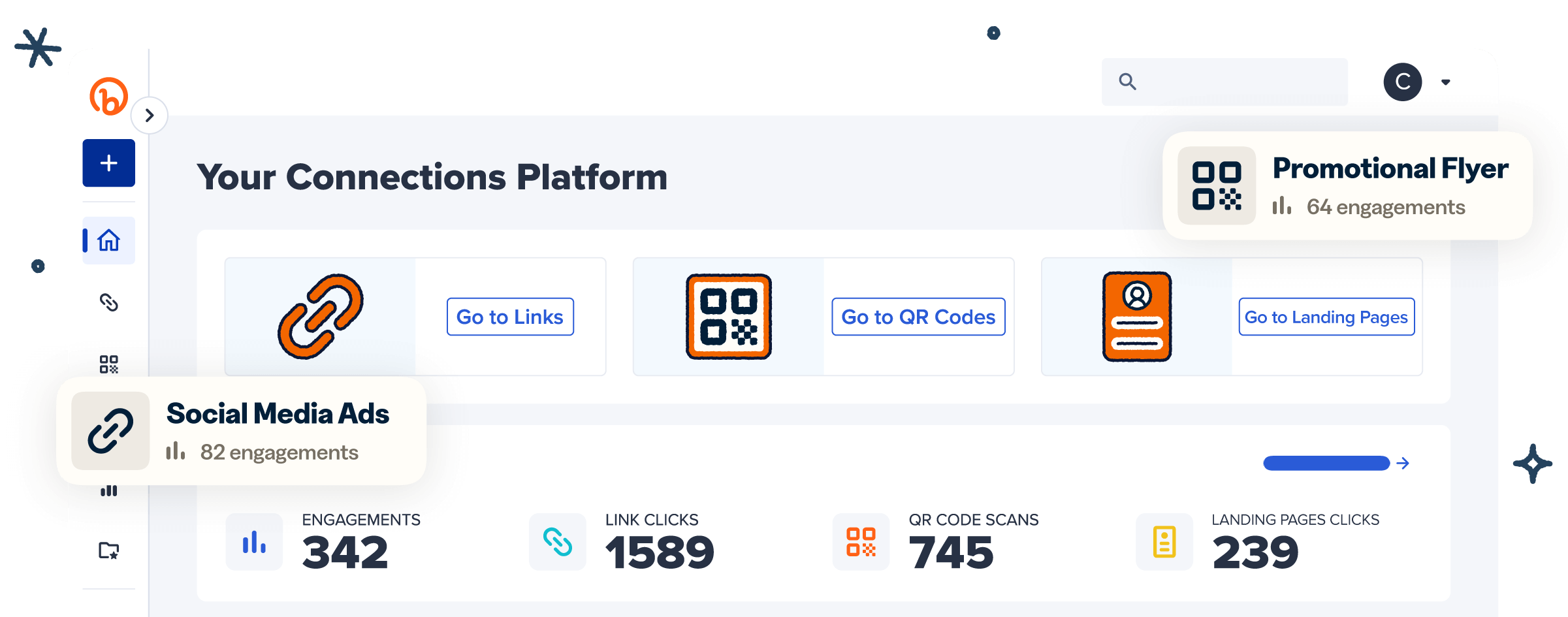
Bitly QR Codes can turn printed materials into digital touchpoints, while Bitly Links create clearer, more recognizable paths across SMS, email, social, and print. Across both, Bitly Analytics helps healthcare teams track clicks, engagement activity, and scans in a single place.
Below, we’ll explore common patient engagement challenges and how connected communication tools can help healthcare organizations create a smoother patient journey.
Note: The brands and examples discussed below were found during our online research for this article.
Key takeaways
- Overcoming customer engagement challenges in healthcare starts with fixing fragmented communication across SMS, print, email, and in-person touchpoints.
- QR Codes and branded short links can turn healthcare touchpoints like intake forms, follow-up materials, and reminders into measurable engagement opportunities.
- Different practices face different engagement barriers, so hospitals, specialists, and med spas often need channel strategies tailored to their workflows and patient relationships.
- Unified analytics may help healthcare marketers see which reminders, scans, and clicks actually drive confirmations, follow-up actions, and campaign performance.
- In healthcare, stronger engagement tools must support compliance planning because scan and click data can create risk when it intersects with protected health information.
Why patient engagement is harder in healthcare than anywhere else
Healthcare patient engagement strategies are more complex than in most industries, as patients move between healthcare providers, scheduling systems, insurance processes, follow-ups, and different communication channels, often at the same time. That makes it harder for healthcare teams to keep engagement simple and consistent.
Providers adopt new solutions to try to keep up with changing patient needs, but often struggle to see value because workflows aren’t connected, onboarding is unclear, or follow-up steps break down between systems and teams. When information doesn’t carry smoothly from one step to the next, engagement drops.
The most effective approach is to move beyond individual tools or channels and look at how everything works together. The rest of this guide walks through how hospitals, specialists, and med spas can evaluate engagement channels and choose the ones patients are most likely to use.
Communication breaks down across too many touchpoints
Healthcare journeys involve more handoffs than most people realize. During a hospital stay, a patient may encounter up to 50 staff members in just four days. Each interaction comes with its own instructions, updates, and next steps, making the experience feel fragmented.
That doesn’t stop at the bedside. Discharge care plans might come from one system, referral follow-ups from another, and appointment reminders from a third. Each message is useful, but they don’t always connect clearly for the patient.
When communication is spread across too many touchpoints, it’s harder to track what’s working—and easier for patients to miss key instructions or follow-ups. Bringing those elements into a more connected flow can help reduce drop-off and improve engagement.
Digital health literacy gaps leave patients behind
Not every patient is equally comfortable navigating digital healthcare tools. Digital health literacy—how easily someone can find, understand, and act on online health information—can become a barrier when systems assume everyone is already familiar with portals, apps, and multi-step workflows.
When that assumption is built in, fewer patients complete the next step. Clear, plain-language content, mobile-first destinations, and multilingual paths remove unnecessary friction and make it easier for patients to take action without needing additional support.
It also helps to design for how people actually use these tools in real life, not how teams expect them to. Scannable QR Codes and simple, readable short links reduce steps for smartphone-first users and caregivers who need to move quickly between information and action.
Compliance constraints shape every tool decision
Healthcare teams rarely choose tools on features alone. Compliance affects almost every decision, shaping what teams can adopt and how quickly they can move.
In practice, that shows up through approval cycles, security reviews, and vendor checks that can slow even simple updates. A new workflow or messaging path often has to pass multiple layers before it reaches patients, and the rules aren’t identical across entities.
Hospitals and medical specialists have to adhere to stricter HIPAA requirements as covered entities. In contrast, med spas and similar businesses may have more flexibility, depending on how they communicate with customers. Those differences often dictate which channels make sense and which ones don’t make it past review.
The engagement channels that actually move the needle
Healthcare professionals need channels that patients notice and can measure. The strongest digital strategies for patient engagement connect physical materials, digital reminders, and campaign data into one clear view.
Often, that looks like a practical mix of SMS, QR Codes, and branded short links. Each plays a different role, but they work best when used together.
- SMS: Strong reach and fast visibility. Patients see it quickly, especially for reminders and time-sensitive updates. Convenience is strong, since there’s no extra step, but measurability depends on what happens after the click.
- QR Codes: Moderate reach, but high convenience in physical spaces like clinics, discharge papers, or signage. Measurability improves when scans tie back to specific locations or campaigns.
- Branded short links: Lower passive reach, but strong convenience in digital contexts, plus the clearest measurability for tracking clicks and attribution across campaigns.
Together, SMS, QR Codes, and short links connect offline touchpoints, digital reminders, and performance tracking in one loop.
SMS outperforms phone calls on reach, cost, and conversion
Phone calls still play a role in healthcare communication, but they don’t scale well for routine engagement. In fact, automated SMS reached 94.5% of patients compared to 45.7% for phone calls, while also improving screening completion rates.
SMS reduces friction in the follow-up process, where phone outreach tends to slow down operations. To evaluate impact, look at response speed, reminder timing, and whether confirmations happen without manual follow-up. These signals give a clearer view of performance than call volume reduction alone.
QR Codes and branded short links turn every touchpoint into a trackable asset
Healthcare communication shows up on clinic posters, discharge paperwork, prescription packaging, and event signage, not just online. While these physical assets are historically tough to measure, QR Codes and branded short links close that gap, connecting physical touchpoints and digital actions.
- A QR Code on a discharge sheet can take patients to follow-up instructions.
- A branded short link on a prescription label can point to dosage details.
- A QR Code on a flyer at a community health event can drive a measurable visit rather than a missed opportunity.
With Bitly Codes and Bitly Links, scans and clicks are trackable, giving healthcare teams a better view of which offline and online channels are driving engagement.
Patient engagement challenges by practice type
Patient engagement isn’t one-size-fits-all. Every provider has the same goal—get patients to act—but very different waiting rooms.
Hospitals juggle coordination at scale, specialists focus on follow-up care and keeping treatment plans on track between visits, and med spas center on loyalty, reviews, and repeat bookings. The channels may overlap, but the workflows behind them don’t.
Hospitals, health systems, and specialist practices: Coordinating care and bridging episodic gaps
Hospitals and specialist practices run on handoffs. They pass along referrals, send home discharge instructions, and schedule follow-ups for days or weeks later, often from different systems that don’t fully sync.
The gaps look different depending on the specialty. Dermatology patients might check in every few months, while chiropractic care hinges on repeat visits to stay on track. Different rhythms, same challenge: keeping patients connected between visits.
QR Codes make intake and education easier at the point of care. Branded short links in SMS and print materials keep follow-up steps simple when patients are on the go. Together, they help bridge the space between visits, without adding more work for busy healthcare staff.
Med spas, aesthetic practices, and independent practices: building loyalty with limited resources
Med spas and independent practices tend to think in terms of customers, not patients, since growth depends on people maintaining memberships, referring friends, leaving reviews, and booking again after seeing posts on social media.
The catch is doing all of that without a large team or heavy systems, so execution has to stay light.
Bitly Codes on in-office signage can point to memberships, promos, or referral perks right where decision-making happens. Bitly Links in SMS campaigns or Instagram bios make it easy to see which offers drive clicks and which are just taking up space.
Even review prompts become measurable with branded short links, giving teams a clearer view of which messages support repeat visits, referrals, and reviews.
How QR Codes solve specific healthcare engagement problems
QR Codes work in healthcare because they eliminate the extra steps of typing and searching—and the resulting confusion. A quick scan gets patients right where they need to go, adding convenience and helping them make more informed decisions about their health.
They also fit naturally into physical spaces like clinics and waiting rooms, where patients are already naturally engaged.
But there’s a big difference between using branded, trackable Dynamic QR Codes and generic Static QR Codes. Healthcare content changes, but printed materials tend to stay in circulation. With Bitly Codes (and a paid Bitly plan), teams can update destinations after materials are printed and view scan activity by location (city/country), campaign, or use case.
Below, we’ll take a closer look at how QR Codes improve the patient experience across different settings.
Waiting room intake: Replace paper forms with a single scan
Waiting rooms still rely on paper more than they need to. A single QR Code can change that, taking patients to digital intake as soon as they arrive.
Instead of clunky clipboards and messy forms that staff have to process later, patients scan the QR Code, fill in their details on their phone, and submit. Or, even better, send out an SMS with a brand short link ahead of time, so patients can provide their info before they arrive.
Either way, staff get complete patient information that’s easier to read and ready to use, while patients get more convenience. It may also reduce manual re-entry, which can lead to errors.
Post-visit follow-up: Dynamic codes that update without reprinting
Post-visit instructions are typically unique to each patient, and even universal information needs regular updates. When a specialist changes aftercare details, the practice switches telehealth links, or marketers start a new seasonal campaign, but the handout is already out the door, it’s a poor patient experience waiting to happen.
Dynamic QR Codes solve that issue, letting teams update the destination without reprinting anything. Patients scan the same code and land on the latest version. So, if a clinic modifies pre-op instructions after refining a surgical protocol, the change can go live immediately.
With Bitly Analytics, teams can even see whether patients scanned the code, giving them an early opportunity to reach out and address any concerns or issues. It’s a proactive way to support both patient satisfaction and better health outcomes.
Patient education and review generation: Link printed materials to current digital content
Printed handouts still matter in healthcare, but they’re more effective when they connect to digital content that stays current. A single QR Code can take patients from an aftercare sheet to updated videos, FAQs, medication guidance, or recovery instructions, without adding another app or login.
What happens after the scan depends on the practice. Hospitals and health systems might focus on education and discharge follow-through, while med spas and independent practices encourage reviews, promote memberships, or entice customers back for another visit.
Instead of sitting forgotten or unused, printed materials become a direct path to action after patients leave the office.
How short links strengthen healthcare marketing campaigns
Short links do more than clean up long URLs. In healthcare marketing, they create clearer handoffs between outreach and action, build trust with patients, and give teams a more reliable way to measure engagement.
In fact, Bitly use cases span the healthcare journey, showing up in appointment reminders, printed handouts, intake instructions, social posts, and follow-up messages.
Long or inconsistent URLs can create hesitation, especially in healthcare settings where trust and clarity matter more to patients. Bitly Links help keep those touchpoints consistent, clear, aligned with your practice—and trackable right alongside your QR Codes.
Attribution across print, email, SMS, and social in one place
Healthcare campaigns often start in unexpected places: a patient sees a billboard with a short URL, they get a referral postcard at checkout, or an email newsletter goes out days after a visit. Add SMS reminders and social platforms to the mix, and it’s easy to see how the same campaign gets scattered across channels.
That’s usually where attribution breaks.
Bitly Links and QR Codes keep those campaigns connected. Whether someone scans a printed code, taps a link in a message, or clicks a URL on social media, teams can see it all in one place. Plus, you easily add UTM parameters to track engagement even deeper through tools like Google Analytics.
No-show reduction through trackable reminder links
While appointment reminders are a great way to keep visits top-of-mind, they also create a clear moment to act. When those reminders include trackable links, teams can see what actually drives follow-through.
Test different timing, message copy, and destination pages against responses—whether patients confirm, reschedule, or choose a different next step. The link turns a basic notification into a measurable data point.
When confirming takes a single tap instead of a call or portal login, fewer steps stand between the reminder and the response.
Analytics, compliance, and HIPAA considerations for link and QR tracking
Healthcare teams need a clear view of what they can measure and how it fits within compliance boundaries.
Patient journeys span print materials, intake forms, SMS reminders, and follow-up emails, but most native tools only show activity within their own channels. That leaves gaps when teams try to understand what leads to engaged patients.
Unified data analytics bring link clicks and QR Code scans into one place, so performance isn’t divided across disconnected reports.
Bitly Analytics centralizes this data, helping teams review engagement patterns without jumping between platforms. With the right governance in place, healthcare marketers can keep reporting organized while complying with HIPAA requirements.
Why siloed analytics miss the full patient journey
Most analytics tools only show what happens inside a single channel. But in healthcare, action usually starts somewhere else, like a clinic poster, mailer, check-in form, or packaging that patients take home.
By the time a patient scans a QR Code or clicks a link, the earlier touchpoint is already invisible in most reporting, and that’s where siloed data breaks down analyses. Signage, print, and digital campaigns end up measured separately, even when they’re part of the same patient decision.
Combining scan and click data in a single view makes it easier to compare which physical and digital assets drive responses, so you’re not treating each format as an isolated result. Teams get a clearer read on what deserves continued spend, instead of trying to piece together partial performance snapshots.
When scan and click data becomes protected health information
Not every scan or click counts as protected health information. Aggregate metrics, like total scans or clicks, are usually non-identifiable and fall under analytics data.
The risk changes when links tie to specific patients, medical records, appointments, or patient care instructions. If a link can be traced back to individual patient data, it falls under HIPAA regulations and needs stricter handling from the start.
Healthcare teams typically review four things during vendor evaluation:
- Whether it requires a Business Associate Agreement (BAA)
- How data is encrypted in transit and at rest
- Who can access reporting.
- How the platform maintains audit logs.
Any solution you choose should support these key governance and compliance capabilities, without relying on integrations with third-party tools.
The ROI case for QR Codes and short links in healthcare
ROI in the healthcare industry usually starts with what you’re already losing:
- Missed appointments and failed follow-ups
- Staff time spent on manual admin and communication
- The costs of reprinting outdated materials
- Omnichannel campaigns that drive action but don’t connect to results
QR Codes and short links help close those gaps, making common workflows more convenient and measurable. Patients show up better prepared, intake moves faster, follow-ups, reviews, and referrals are easier to complete. Teams also get clearer attribution to determine what’s working.
The cleanest way to validate ROI is to focus on one workflow first, like intake, reminders, or follow-ups. Establish current performance before making any changes, then introduce trackable links or QR Codes into that specific flow.
From there, review results weekly, tweaking resources or approaches as needed, then expand into additional workflows once positive outcomes are both clear and repeatable. But don’t stop analyzing and optimizing once everything is up and running. Keep tracking performance and iterating for continuous improvement.
Better patient engagement starts with better connection infrastructure
Healthcare engagement works best when every touchpoint gives patients a clear next step. QR Codes and short links connect those engagement opportunities, turning printed materials, reminders, and digital campaigns into simple paths that move patients further along in their healthcare journeys.
Bitly brings those touchpoints together with branded short links, Dynamic QR Codes, and united analytics that help healthcare teams measure engagement across physical and digital channels.
Explore Bitly plans today to simplify patient communication and improve follow-through across appointments, intake, and aftercare.
FAQs
What are the biggest customer engagement challenges in healthcare?
The hardest part is keeping communication clear across many touchpoints while meeting privacy requirements and serving people with very different levels of digital comfort. In practice, hospitals, specialists, and med spas each need connected, trackable journeys that reduce friction before, during, and after a visit.
How can healthcare practices reduce appointment no-shows with digital tools?
SMS reminders usually outperform phone outreach because they’re faster, cheaper, and easier for patients to act on immediately. Using Bitly Links lets you track confirmations, test send times, and see which reminder messages drive bookings or reschedules.
How do QR Codes improve patient engagement in clinical settings?
QR Codes can turn waiting rooms, discharge packets, signage, and prescription materials into simple digital entry points for forms, education, and follow-up. With Bitly Codes, you can update destinations without reprinting and measure scans alongside short-link clicks in one analytics workflow.
What engagement strategies work best for hospitals, specialists, and med spas?
Hospitals often need wayfinding, intake, and follow-up tools that connect scattered touchpoints, while specialists need adherence and reactivation across longer care gaps. Med spas usually benefit from branded short links, QR Codes, and review flows that support repeat visits, loyalty, and measurable campaign attribution.
What should healthcare marketers look for in link and QR tracking tools?
Start with governance: you may need a BAA, strong access controls, audit trails, and clear rules for when click or scan data becomes PHI. Bitly Analytics may help by unifying short-link clicks and QR Code scans, so you can compare channels without stitching together siloed reports. That gives your team a cleaner view of ROI and faster decisions when you’re ready to scale.