
Churn goes up. Retention costs follow. Then comes the familiar question: Is another discount campaign really the answer?
The problem is that discounts buy time, not loyalty. When customers are dealing with disconnected experiences, inconsistent communication, or frustrating service handoffs, a lower bill rarely changes the outcome for long.
That’s why more teams are turning their attention to the telecom customer engagement challenges that surface before a customer ever decides to leave. The warning signs are usually there early, but knowing where to look and what to fix first is where most programs stall.
This guide breaks that process into three phases: spotting early churn signals, fixing handoffs across channels and teams, and measuring every touchpoint consistently so retention efforts become easier to evaluate and improve over time.
Note: The brands and examples discussed below were found during our online research for this article.
Key takeaways
- Discount-first retention rarely fixes the service, relevance, and handoff failures that actually drive churn. It trains customers to wait for a better price while the real problem goes unaddressed.
- Legacy infrastructure and data silos create a readiness illusion: dashboards look informed, but outreach still misses timing, context, and channel continuity when it matters most.
- App-first and OTT subscribers can leave before a save offer ever reaches them. Retention teams need earlier behavioral indicators, not faster discount delivery.
- Subscribers who engage across multiple channels and touchpoints often show higher ARPU and lower churn. That behavior is measurable and worth prioritizing.
- Physical touchpoints like packaging, bills, and retail displays are attribution blind spots for most telecom teams. Trackable links and QR Codes can help bring more visibility to those interactions without requiring a complete reporting overhaul.
Why discounts alone are losing the churn battle
Discounts can slow churn for a while. A lower bill or limited-time offer might keep someone from canceling this month, but if the real issue is a frustrating customer experience or poor communication, pricing only goes so far.
There’s a long-term cost, too. The more often customers see discount offers, the more likely they are to wait for the next one. That erodes margins and makes the service feel less valuable over time.
The deeper problems that lead to churn usually happen across channels and teams. Customers get inconsistent messaging, support lacks context, and marketing data stays siloed. Without effective coordination and personalization, it’s much harder to understand what keeps customers engaged—or act on those signals in time.
The real cost of discount-first retention
Not every saved customer is a long-term win. A bill credit might prevent a cancellation in the moment, but the tradeoffs often show up later: lower average revenue per user (ARPU), reduced customer loyalty, and less understanding of why customers disengage in the first place.
Here’s a simple example: A customer calls in frustrated about ongoing billing errors. A $20 credit keeps them from canceling, but the underlying issue hasn’t been resolved. A few months later, they leave anyway.
Because the save “worked,” the real story goes overlooked. Was it billing friction, a service issue, or a breakdown between teams? When discounts do most of the work, the underlying causes stay buried instead of getting fixed.
What customers actually want before they leave
Most customers don’t leave over prices. They leave when something feels harder than it should. A billing question takes too long to resolve, a network issue keeps coming back, or a device constantly needs to be reset.
What they’re really looking for is clarity and speed. Rising customer expectations have made consistent, connected experiences more important than ever. Customers want answers that make sense, and context that carries across chat, phone, and self-service so they don’t have to repeat themselves.
Think about a roaming charge dispute or a loyalty question. When the experience works seamlessly across channels:
- The customer calls or chats about their issue.
- They get a prompt response.
- A friendly, knowledgeable agent uncovers and fixes the problem.
- The customer relationship grows.
When that doesn’t happen, frustration builds over time. That’s what leads to churn—long before any discount conversation happens.
The root causes of telecom customer engagement challenges
Telecommunications engagement breaks down when data, delivery systems, and teams aren’t working from the same signals. When you use one platform to capture customer engagement data and another to act on it, you lose context in between.
Churn rises when those early signals don’t connect. A billing issue here, a network complaint there, a failed service interaction somewhere else. None of it builds a complete picture until it’s too late.
The underlying problem is visibility and coordination. Brands struggle to recognize risk early, carry context across channels, and measure touchpoints consistently. In fact, PwC notes that fragmented systems, disconnected data, and operational complexity can significantly slow telecom transformation efforts, even when the strategy is clear.
That same challenge shows up in customer retention programs. They often launch with clear intent but lose impact when signals don’t translate into coordinated action across systems and teams.
Legacy infrastructure fragmentation
Customer context in the telecom industry spreads across multiple systems. Billing tracks payments, customer relationship management (CRM) tracks interactions, network tools track performance, and customer support systems track issues. Each holds a piece of the journey, but none connect it end to end.
That breakdown shows up in simple moments. Someone finishes a chat about slow speeds and gets an upgrade offer the same day. They visit a store for help shortly after, but the conversation starts from scratch because the chat never carries over. The next follow-up message goes out anyway, without any awareness of either interaction.
The experience feels disconnected even when nothing looks obviously broken. Outreach becomes harder to time, harder to personalize, and harder to tie back to what people actually need.
Data silos and the perceived readiness illusion
Telecom companies know where their data lives: CRM, billing, network dashboards, and support tools. The challenge is turning that visibility into action.
A spike in failed payments, repeated support contacts, or negative customer feedback may be visible across separate systems, but pulling those signals together fast enough to act on is rarely straightforward. By the time you have the pieces connected, the customer has already moved on.
This is the perceived readiness illusion: access to data without the ability to use it when it matters.
Knowing where information lives isn’t the same as being able to act on it when behavior starts to shift. In churn situations, the delay between signal and response often determines the outcome.
The omnichannel handoff problem
Telecom sector journeys rarely fail within a single channel. They fail when customers move between them.
Try tracing a simple path: a customer replies to an SMS about a billing issue, moves into app chat for more detail, and ends up calling support when nothing gets resolved. Each channel works as intended, but context doesn’t carry forward, so the customer repeats themselves at every step.
To spot this in your own setup, track one support issue across channels. Look at what context transfers, what gets dropped, and where agents have to start over.
Simply adding more channels won’t fix this. Without managing omnichannel engagement across them, each new entry point just introduces another place for context to reset.
How to tell if your engagement infrastructure is actually broken
Most teams assume their stack is working as long as campaigns are running and customer data is rolling in. But the real question is whether that data changes what happens next.
A quick way to check is to look at how your engagement system behaves across the customer journey:
- A customer moves from SMS to app to call center, but context doesn’t follow them
- Retention offers go out on a schedule, not in response to what the customer just did
- Offline moments like bills or packaging exist, but don’t connect back to digital behavior
- Channel teams report engagement separately, rather than sharing a single subscriber view
- Save results are measured in isolation, without knowing what interactions led up to them
If more than one of these issues sounds familiar, the problem is structural. So let’s look at what to fix first and how to move from scattered signals to a system that responds the right way at the right time.
How OTT and app-first subscribers changed the churn timeline
In contract-heavy models, churn unfolds over longer cycles and is easier to anticipate. But app-first and over-the-top (OTT) services subscribers don’t give much warning. They can drop off quickly if the experience slips, making late save offers less effective than they used to be.
When it’s easy to cancel or switch, retention timelines shift earlier in the journey. Customers can move from frustration to cancellation much faster than they could in traditional telco, giving teams less time to intervene before churn occurs.
In a telecom services environment, waiting for cancellation intent is too late. What matters is how quickly signs of disengagement surface and connect to action before drop-off happens.
Zero switching friction and the compressed intervention window
Zero switching friction means there’s nothing slowing a customer down if they want to leave. There aren’t any contracts to wait out or penalties to reconsider, and it’s simple to move to a competitor.
When switching is that easy, the timeline shrinks. A few bad sessions, a delayed support response, or a failed upgrade can be enough to trigger churn before any save effort even launches.
This shift is especially visible with enterprise telecom customers. Cloud-based technologies like unified communications as a service (UCaaS) and software-defined wide area networking (SD-WAN) have shortened onboarding timelines and reduced setup friction, removing many of the delays that once slowed provider changes.
That leaves retention teams with less time to react. If risk signals don’t surface early, a customer may already be halfway through the move before anyone attempts to win them back.
Why early behavioral signals matter more than late-stage offers
Many retention programs spend too much time at the end of the journey on save offers, cancellation flows, and last-minute outreach. For app-first telecom providers, the more useful signals usually appear much earlier.
A drop in app logins, ignored service links, lower loyalty engagement, or fewer self-service interactions can all point to disengagement before a customer ever reaches a cancellation page. Those are live indicators that customer satisfaction is starting to change—and they typically show up while there’s still room to respond.
Many telecom teams don’t measure churn until cancellation intent becomes obvious. By then, the relationship has usually been weakening for a while. Early engagement patterns make the warning easier to see before the customer is already on their way out.
The tracking and connecting pattern: Your highest-value customers are telling you something
High-value subscribers rarely interact with a telecom brand once and disappear. They compare plans, click service links, scan bills, revisit the app, contact support, and check loyalty offers over time.
Viewed separately, those actions can look random. Together, they often point to an engaged customer who is still invested in the relationship.
That’s useful for retention, since engaged subscribers leave signals behind long before churn risk becomes noticeable. Someone checking upgrade options, opening support messages, and returning to the app regularly shows a very different usage pattern than someone slowly disappearing from every channel.
Service interactions, app activity, and loyalty participation all add context. Measuring them together makes it easier to spot which customers are still engaged and which ones are starting to pull away.
What this behavior looks like in telecom
A customer logs in to the app to check data usage, taps a loyalty offer sent via SMS, then scans a bill link to review charges instead of calling support. Later, a service update notification brings them back into the app to compare upgrade options.
Another customer may start in-store, where a receipt includes a QR Code that routes them back to the app to finish setup or confirm account details.
These are the kinds of observable actions that Bitly Links, Bitly Codes, and Bitly Analytics can help teams measure across SMS, email, app experiences, and retail channels. Viewed together, those interactions provide a more complete picture of engagement than any single click, scan, or visit.
How to identify these customers in your existing data
You don’t have to build a whole new model from scratch to find your engaged customer base. Most of the signals you need are already in your reporting:
- Branded link clicks: Customers who click across different campaign types, including billing updates, support messages, and loyalty offers, more than once within a 60–90 day window.
- QR Code scans: Customers who scan a physical touchpoint and then take a digital action, like checking account details, comparing plans, or enrolling in a loyalty program.
- Cross-channel activity: Customers who engage across at least two channels, including SMS, email, app, or physical touchpoints, within the same billing cycle.
Even without perfect data connections, these patterns can still emerge. Actions like repeated clicks across campaigns or QR Code activity tied to digital engagement can help teams identify audiences that are actively engaged. At the first signs that engagement is slipping, they can prioritize outreach to get ahead of churn.
How cross-channel engagement correlates with ARPU and retention
Some customers don’t stick to one channel. They move between the app, billing messages, SMS offers, and support interactions as they manage their account, and that pattern shows up in the data. Broader engagement across channels often lines up with higher ARPU and lower churn.
For retention teams, that makes measurement a priority. If cross-channel behavior isn’t visible together in one place, it’s harder to evaluate which loyalty programs may be contributing to customer activity and long-term value.
What’s left is a fragmented view: campaign results by channel, without a clear understanding of how customers move between them.
Closing the physical-to-digital attribution gap
Telecom maintains a significant retail presence alongside digital channels. Even for providers without physical stores, assets like packaging, bills, inserts, and event materials all create moments where customers engage in the real world.
The challenge is what happens next. Most teams track digital clicks closely, but offline interactions often disappear right after they happen. A bill insert or in-store display might meaningfully impact a customer relationship without ever showing up in reporting.
QR Codes can make those experiences both more convenient and more measurable. With Bitly Codes, a scan on a bill, package, or sign can take customers to the next step in the journey, while also providing an easy, cost-effective way to measure engagement from physical touchpoints.
The measurement gap in telecom’s physical footprint
Retail signage, device packaging, direct mail, and paper bills often drive action without ever showing up cleanly in digital reporting. A customer notices a store display or bill insert that later influences an app visit or activation, but the path between those moments isn’t visible.
In most reporting setups, that influence gets flattened or reassigned to the last digital click before conversion. Store visits tie back to search, and the impact of packaging or print disappears from the attribution story entirely.
That creates a real gap for teams responsible for activations, in-store performance, or packaging campaigns. The work drives behavior, but they don’t have a reliable way to measure in-store customer engagement and capture that ROI.
Using QR Codes on device packaging, bills, and retail materials
QR Codes fit naturally into the customer journey, especially when people need information, guidance, or support. On device packaging, they can point to setup steps or activation flows, keeping them current without reprinting.
Other common telecom use cases include billing explainers, device setup flows, plan comparisons, and event-specific offers. QR Codes make these experiences deliverable through billing statements, device packaging, retail displays, and event signage, helping customers access relevant information on demand, right when they need it.
With Dynamic QR Codes, those destinations aren’t fixed. Teams can update where a scan leads without reprinting materials, keeping information accurate and consistent across packaging, bills, and retail placements.
Turning offline touchpoints into trackable digital engagement
With Bitly Codes, a scan from packaging or in-store signage can route customers to a Bitly Page, support content, or live offers, while also generating scan data that feeds into broader campaign reporting. That makes the scan part of the same journey, instead of a standalone event.
This kind of visibility is becoming increasingly important as marketers look beyond basic campaign reporting and toward measurement models that better connect engagement to outcomes. Nielsen’s work on predictive sales lift measurement reflects that shift, using stronger marketing signals to help anticipate results rather than relying solely on post-campaign reporting.
For telecom teams, that direction highlights a familiar gap: physical and digital touchpoints often sit in separate reporting views, even when they influence the same customer behavior.
Building a multi-touch attribution framework for telecom’s channel mix
Most telecom reporting still breaks down by channel. SMS gets its own dashboard, email has its own metrics, app engagement sits elsewhere, and QR scans live in another platform. That makes it difficult to understand how customers interact throughout the broader customer journey.
The limitation becomes obvious when you try to compare performance. If a campaign spans SMS, email, in-app prompts, and QR touchpoints, there’s often no clear way to see how those channels work together or how engagement progresses from one interaction to the next.
Bitly Analytics helps bring clicks, scans, campaign performance, and UTM structure into one view. When those signals sit side by side, teams can evaluate performance in context instead of isolation.
Why last-click attribution misrepresents retention investment
Last-click attribution gives full credit to the final touchpoint. In telecom, it’s often an SMS or last-minute offer that convinces the customer to stay, even though meaningful interactions may have happened much earlier.
An app login, billing page visit, or QR scan on a statement may have already indicated renewed interest before that final message appears.
Those earlier interactions rarely show up in the same reporting view. As a result, single-channel metrics can look strong on their own without showing the broader sequence of customer activity.
Unifying SMS, email, in-app, and physical QR performance data
Branded short links bring SMS and email into a shared tracking layer, while QR Codes extend that same visibility into packaging, bills, and in-store materials. Each interaction gets logged in the same place instead of being split across separate reports.
Connecting messaging, links, and analytics helps streamline reporting by reducing the need to move between dashboards to understand what happened next. Teams can better follow how customers move between digital and physical experiences, so they can start to look at the journey as a whole.
Stop leaving engagement data in silos and start connecting the dots with Bitly
Telecom retention fails when customer interactions, engagement data, and reporting live in separate places. The brands that reduce churn most effectively are often the ones that can recognize patterns earlier, preserve context across touchpoints, and measure engagement consistently throughout the customer journey.
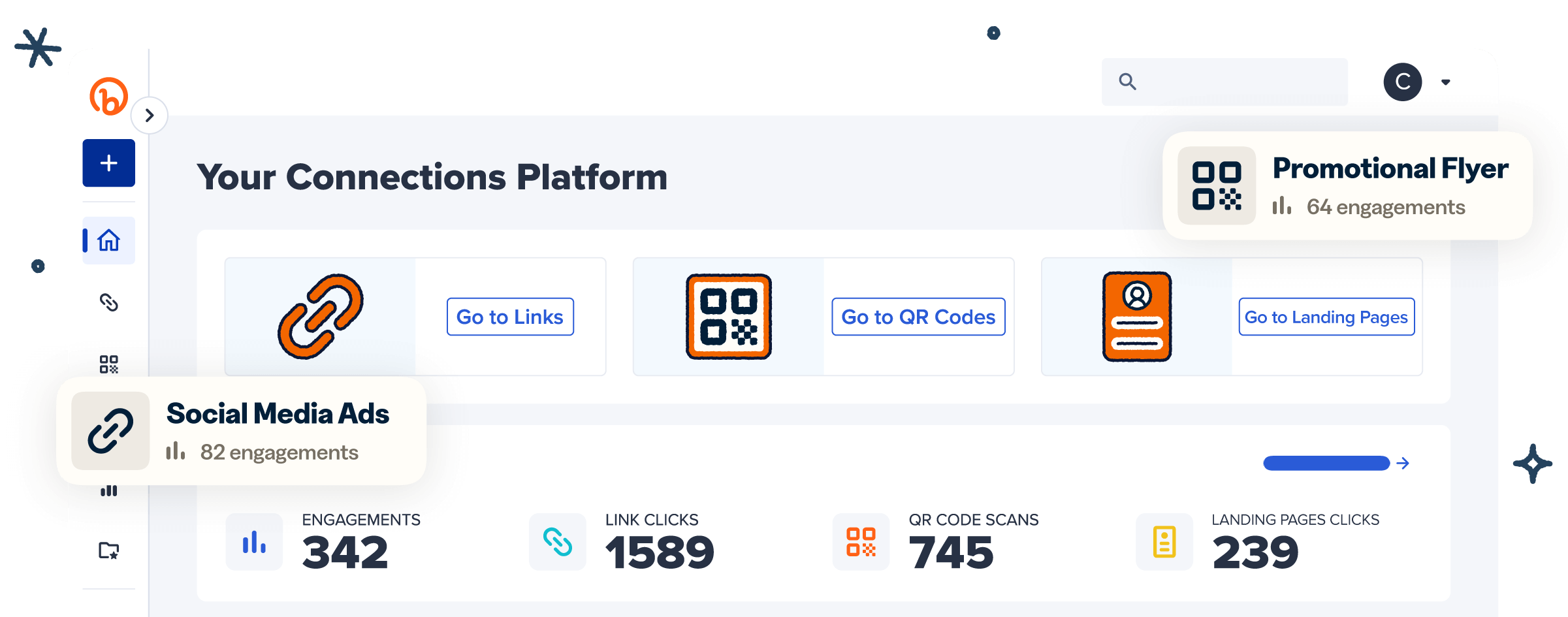
Bitly Links, Bitly Codes, and Bitly Analytics bring clicks, scans, and campaign performance into a single reporting layer. For enterprise teams, single sign-on (SSO), APIs, and governance controls support security and data requirements without slowing execution.
Together, these tools deliver a clearer view of customer activity, from QR Code scans and link clicks to in-store engagement and campaign interactions.
Explore Bitly plans and pricing to see how connected measurement can help your telecom strengthen retention and better understand customer behavior.
FAQs
What are the biggest telecom customer engagement challenges?
Most telecom engagement problems start with fragmented systems, disconnected channel data, and handoffs that strip context when customers move between SMS, apps, email, and chat. That breakdown makes personalization harder, slows response times, and leaves marketers with activity data that looks complete but is difficult to activate. In the telecommunications industry, the challenge is rarely effort alone. It’s connecting every touchpoint quickly enough to influence retention before frustration turns into churn.
Why do data silos hurt telecom customer engagement?
Data silos keep billing, usage, service, and campaign signals in separate places, so teams may see customer history without being able to act on it. That creates a readiness illusion: your dashboards look informed, but your outreach still misses timing, relevance, or channel continuity. Bitly Analytics may help by bringing clicks, scans, and page engagement into one view, making cross-channel patterns easier to identify.
How has app-first behavior changed telecom retention?
App-first and OTT subscribers can leave quickly, which compresses the window for retention from a campaign problem into a moment problem. By the time a cancellation offer appears, the customer may already be gone, so early behavioral signals matter more than late-stage discounts. Branded short links in SMS, email, and in-app experiences can help marketers monitor intent shifts sooner and respond with more relevant journeys.
How can telecom brands connect offline and online engagement?
Telecommunications companies often have a large physical footprint, but their packaging, bills, retail displays, and event materials sit outside digital attribution. QR Codes can bridge that divide by turning store signage or device inserts into trackable visits, support actions, upgrades, or loyalty enrollments. With Bitly Codes and Bitly Analytics, teams can compare scans and clicks in one place, making omnichannel performance easier to understand.