
Affiliate marketing apps help brands recruit partners, issue trackable links or codes, attribute sales, and pay commissions so you can skip bolting together spreadsheets and chat threads. In 2026, you should be comparing more than feature lists; consider software that supports creators, Shopify workflows, cleaner attribution, and fraud controls. And partners still need links people will actually click.
American advertisers spent $12.42 billion on affiliate marketing in 2025, an 11.3% year-over-year increase, but search results for “affiliate marketing apps” mix Shopify App Store listings, program platforms, mobile “learn affiliate marketing” apps, and link tools. This guide focuses on business software that runs or supports an affiliate, referral, or creator program. It also covers the link layer partners need to share offers cleanly.
Use the checklist and comparison below to shortlist faster, including where Bitly Links, Bitly Codes, Bitly Pages, and Bitly Analytics fit.
Note: The brands and examples discussed below were found during our online research for this article.
Key takeaways
- Match the app to your program model first. Shopify-native apps, multi-channel partner platforms, and creator referral tools solve different jobs. Shortlist by store stack and partner type before you compare pricing.
- Prioritize tracking you can trust. Look for clear attribution, unique links and code counts per partner, fraud controls, and reporting you can integrate across the rest of your marketing stack.
- Give partners short, manageable links people will click. Pair your affiliate platform with branded short links, QR Codes, and link-in-bio pages. Ensure you can pack long tracking URLs full of UTM parameters into short links that won’t tank trust on social, SMS, or product packaging.
- Treat creators like a first-class channel. Programs that support unique creator links, payouts, and performance views scale faster than programs that only chase coupon publishers.
- Check pricing and plan details before you commit. Affiliate app pricing changes often, so verify live plan details.
What to look for in an affiliate marketing app
Start your shortlist with how you recruit partners, attribute results, and integrate with the rest of your stack, not with the longest feature page.
Tracking and reporting
Affiliate marketing apps should attribute clicks, sign-ups, and sales to the right partner with unique links, coupon codes, or both. You need click-to-conversion visibility, flexible date ranges, partner-level performance, and succinct reports you can export and integrate across your stack. Many brands are also looking beyond “last-click-only” thinking as multi-touch journeys and first-party tracking become increasingly important.
Must-haves:
- Unique links or codes per partner
- Clear conversion and commission reporting
- Exportable data for finance and marketing tools
Partner recruitment and management
Affiliate management apps provide partners with a portal, application and approval workflows, and a way to share creative assets. Marketplace discovery helps when you need new publishers. Communication tools, tiered commissions, and automatic customer-to-affiliate enrollment matter for referral-led brands that turn buyers into promoters.
Ecommerce and stack fit
Filter by Shopify, WooCommerce, software as a service (SaaS) billing, or multi-store needs before you rank tools by feature count alone. Native checkout compatibility and clean integrations beat a longer checklist that breaks after install. Shopify merchants should start with native affiliate marketing tools. Then add cross-channel layers as the program scales.
Fraud, compliance, and brand safety
Mature programs need coupon-code leak detection, controls for suspicious traffic, and role-based permissions to prevent the wrong teammate from changing payout rules. US programs should also set clear expectations in line with the Federal Trade Commission (FTC) Endorsement Guides, requiring creators and affiliates to disclose all material connections.
Link experience for partners and customers
Program software creates the tracked offer. The sharing layer still needs clean branded links, mobile-friendly destinations, and offline options like QR Codes. Bitly sits beside your affiliate platform, providing that synergistic link and measurement layer. It’s not a full network or payout engine.
Minimum viable checklist
- Unique partner tracking (links, codes, or both)
- Partner portal plus approval workflow
- Native fit for your store or billing stack
- Fraud or leak controls you will actually use
- Exportable reporting
- A plan for branded public links, QR Codes, and campaign analytics
Affiliate marketing apps compared
Use this table to shortlist affiliate marketing platforms by what you need done. Then read the profiles below for correct fit details. Pricing postures reflect public plan pages checked in September 2026, so verify live rates before you buy.
| App | Best for | Core strength | Starting price posture | Key consideration |
|---|---|---|---|---|
| Bitly | Link, QR Code, and landing-page layer for any program | Branded short links, Bitly Codes, Bitly Pages, Bitly Analytics | Free plan available; paid plans scale by volume | Link-layer maximization tool; not a full affiliate network or payout engine |
| UpPromote | Shopify brands building a dedicated affiliate program | Marketplace discovery + Shopify-native management | Free tier available; paid plans add scale features | Confirm referral fees / order caps on current plans |
| Goaffpro | Stores that want a generous free start | Free-to-start Shopify program tools with room to scale | Free + paid premium | Confirm free-plan caps and reporting depth |
| ReferralCandy | Brands combining referrals and affiliates | Customer referral automation + affiliate layer | Paid plans with success fees | Pure affiliate-only power users may want a specialist solution |
| Refersion | Higher-volume or multi-channel programs | Partner onboarding and network-style workflows | Free + Paid professional tiers including income percentage | Price and complexity can exceed small and midsize business (SMB) needs |
| Social Snowball | Direct-to-consumer (DTC) brands turning buyers into promoters | Automatic customer-to-affiliate flows | Paid tiers only | Validate fit if you need classic publisher networks |
| Affiliatly | Smaller Shopify / Woo programs | Tracking and program setup | 90-day free trial, paid plans by affiliate count | Lighter on advanced marketplace features |
| LeadDyno | Ecommerce and SaaS teams launching affiliate programs | Quick program launch and multi-action rewards | Paid affiliate-based pricing; visitor-based pricing on some older plans | Pricing model needs careful capacity planning |
| Impact.com | Enterprise brands recruiting at marketplace scale | Large partner ecosystem and automation | Custom / higher-end pricing | Often more than early-stage programs need |
The best affiliate marketing apps for 2026
These nine options cover Shopify-native apps, multi-channel partner platforms, and referral-led tools. They also cover the link layer that helps partners share and measure promotions.
1. Bitly
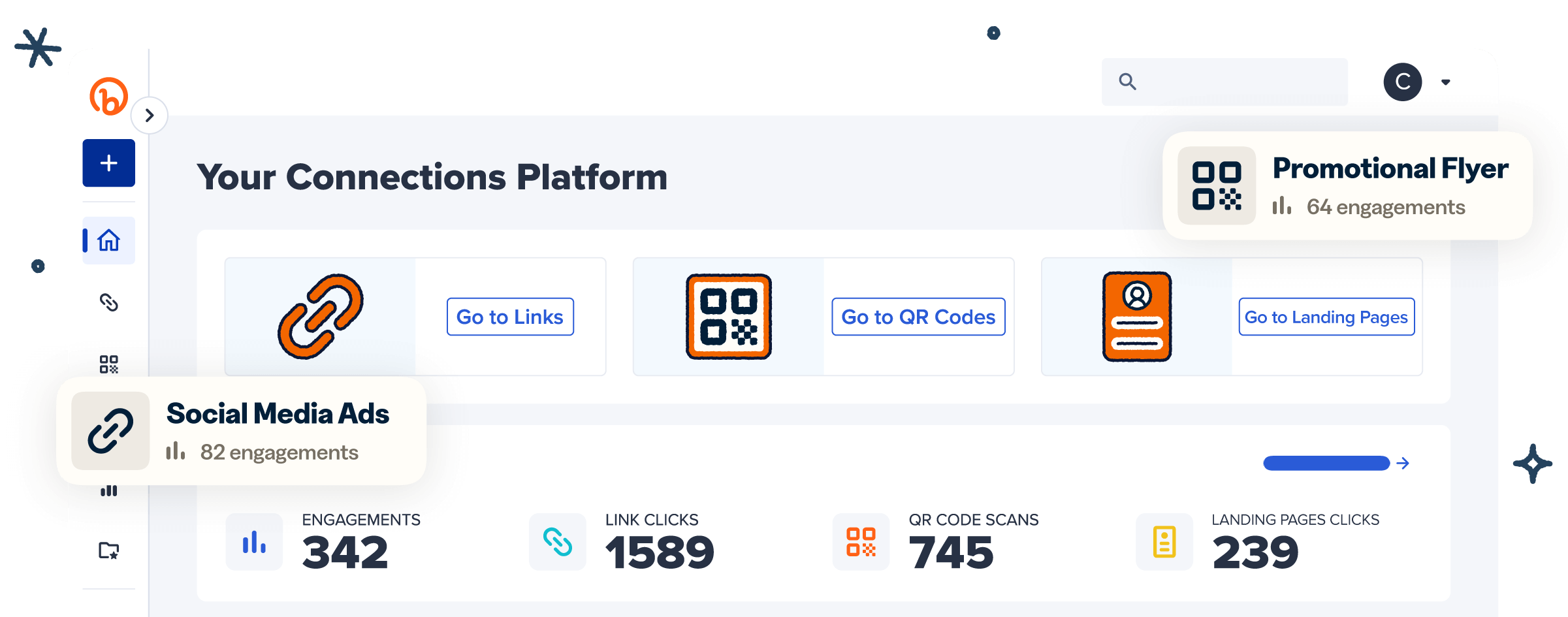
Bitly is the link and QR Code management layer that sits beside your affiliate platform. Partners can share branded short links, Bitly Codes, and Bitly Pages while you track engagement in Bitly Analytics.
- Generate and brand affiliate links. Long network URLs rarely look trustworthy in social captions, SMS, or bios. Shorten them with a URL shortener. Preserve tracking parameters, add custom back-halves, and use branded links so offers match your domain.
Branded links earn 2.3x more clicks than unbranded ones. For a deeper walkthrough, see how to shorten affiliate links.
- Personalize creator and influencer branding. Assign unique vanity paths per partner to keep attribution clean. Each promoter gets a link that feels intentional. Personalized URLs help when you run many creators at once.
As one customer plainly puts it, “I love being able to easily and quickly create short URLs for our social media campaigns. I also use it to help track influencer performance with assigned short links for each influencer.” - Create talent destinations with Bitly Pages. Give creators one mobile hub for multiple offers instead of a single raw redirect. A link-in-bio page keeps seasonal drops, evergreen products, and disclosure copy in one place. Partners can update it without having to hunt through old posts.
- Expand physical channels with Bitly Codes. Extend affiliate and referral offers onto packaging, inserts, events, and retail with QR Codes. Dynamic destinations let you change the landing experience without reprinting any physical materials.
- Capture meaningful data with Bitly Analytics. Review clicks and scans by channel, geography, device, and date in Bitly Analytics. Add UTM parameters (campaign tracking tags) when you need campaign context alongside partner IDs from your affiliate app.
- Integrate and scale with pre-built solutions from the Bitly Marketplace. Connect Bitly to Shopify, HubSpot, and workflows across 3,400+ connected apps, with 60+ marketplace integrations.
Start on our Free plan if you want to test integrations or workflows. It includes 1000 direct calls to our open API every month, more than enough to see how we fit into the rest of your stack.
Pricing: Five tiers: Free at $0; Core at $10/mo, which is annual-billing only and works out to $120 charged yearly; Growth at $29/mo annually ($348/year, versus $35/mo on monthly billing); Premium at $199/mo annually ($2,388/year, versus $300/mo monthly); and Enterprise at custom pricing. Tiers scale by monthly link, QR Code, and landing-page volume rather than seats.
Bitly is not a full affiliate network, commission engine, or Shopify affiliate marketplace. We provide the share-and-measure layer campaigns need to understand how partners’ links operate in the wild.
2. UpPromote
UpPromote is best for Shopify brands that want program rules, partner portals, and marketplace discovery. It also keeps reporting inside the store workflow.
Key features:
- Offer rules and promotional structures for different partner tiers
- Affiliate marketplace listing plus direct invites
- In-app communication for email and chat with partners
- Dashboards and reports for partner performance
- Branding controls for the affiliate-facing experience
Pricing: Four tiers, all with a percentage fee on referral sales layered on top of the subscription. Free at $0; Growth at $24.99/mo on yearly billing ($299.90/year) plus 2% of successful referral sales; Professional at $74.99/mo yearly ($899.90/year) plus 1.5%; and Enterprise at $166.66/mo yearly ($1,999.90/year) plus 1%.
Yearly billing saves 17% against the monthly rates of $29.99, $89.99, and $199.99. A Creator Discovery add-on starts at $39/mo on any plan, and Shopify Plus merchants get custom quotes.
3. Goaffpro
Goaffpro is best for Shopify and multi-store teams that want a free start, branded portals, and room to grow into payout automation.
Key features often include:
- Free-tier support for early programs
- Branded affiliate portals and store-connected tracking
- Analytics for partner activity
- Automated payouts on higher plans
- Tiered commission options on supported plans
Pricing: Four tiers, monthly only: Hobby is free with unlimited affiliates, sales, and revenue; Premium is $49/mo; Business starts at $99/mo; and Enterprise is quote-based. Both Premium and Business come with a 15-day free trial.
No annual payment option is available, so the monthly rate reflects the effective annual cost (roughly $588/year for Premium, $1,188/year for Business).
4. ReferralCandy
ReferralCandy is best for ecommerce brands that want customer advocacy and affiliate partners in one system, especially on Shopify.
Key features often include:
- Automated post-purchase sharing prompts
- Rewards for customer referrals alongside affiliate tracking
- Affiliate dashboards and flexible payout options
- On-site widgets and campaign controls for word-of-mouth loops
Pricing: Four tiers, each a flat fee plus a success fee on referred sales: Basic at $39/mo plus 10.5%; Grow at $79/mo plus 3.5%; Scale at $249/mo plus 1.5%; and Enterprise at $799/mo plus 0.25%, which adds dedicated onboarding and an account manager.
Every plan includes the same feature set, so moving up a tier only buys down the success fee. There is no annual commitment; every plan is month-to-month, and additional stores are a flat $20/mo each. The success fee applies only to each referred customer’s first three orders.
5. Refersion
Refersion is best for higher-volume or multi-channel programs that need broader publisher and creator onboarding. It suits conversion-based packaging.
Key features often include:
- Partner discovery and onboarding workflows
- Performance tracking across affiliates and content partners
- Analytics and reporting for conversion-driven programs
- Integrations with major ecommerce platforms and marketing tools
Pricing: Four tiers, with annual billing saving 20%: a free Marketplace Listing; Launch at $29/mo billed yearly ($39 monthly) plus 3% of affiliate-driven sales; Growth at $159/mo billed yearly ($199 monthly) plus 2%; and Scale, which is quote-based for brands above $1M GMV and moves to a flat monthly subscription.
That puts Launch at roughly $348/year and Growth at roughly $1,908/year before the percentage fee. Refersion’s own comparison content puts Scale at $599/mo, or $479/mo on annual billing with 0% transaction fees for stores up to $1M GM. That’s useful as a reference point, though it isn’t on the pricing page.
6. Social Snowball
Social Snowball is best for DTC brands that want every buyer to become a promoter. It relies on automatic customer-to-affiliate loops.
Key features include:
- Automatic enrollment that turns customers into affiliates
- Creator and influencer management in one dashboard
- Email communication tools
- Attribution and ROI reporting
- Coupon-code leak detection for brand safety
Pricing: Two tiers, both custom-quoted with published floors: Snow Day, the self-serve package, starts at $249/mo plus 3% of affiliate-generated revenue and caps you at 4 programs and 3 signup forms; Blizzard, the white-glove package, starts at $899/mo with no commission fees ever, and unlocks unlimited programs, TikTok Shop affiliate management, Creator Search, social listening, priority support, and a dedicated account manager.
No annual pricing is published, and there are no contracts. Users simply cancel by uninstalling.
7. Affiliatly
Affiliatly is best for smaller Shopify or WooCommerce programs that mainly need tracking, a portal, and management without a heavy marketplace layer.
Key features often include:
- Affiliate link creation and sharing
- Program branding and partner management
- Analytics across the affiliate program
- Integrations with Shopify, WooCommerce, and other retail platforms
Pricing: Seven tiers, priced by active affiliate count and billed monthly: Free at $0 for up to 50 tracked orders; Starter at $16/mo for 50 affiliates; Advanced at $24/mo for 200; Professional at $39/mo for 500; Pro 1000 at $59/mo; Pro 2500 at $79/mo; and Pro Unlimited at $129/mo for unlimited affiliates.
All plans carry unlimited orders, no additional charges beyond the subscription, and a 14-day free trial. There’s no annual option, so Pro Unlimited runs about $1,548/year at list.
8. LeadDyno
LeadDyno is best for ecommerce and SaaS teams that want program setup without heavy developer work, multi-action rewards, and platform integrations.
Key features often include:
- Quick affiliate program launch without heavy developer work
- Rewards for clicks, leads, and sales
- Campaign analytics and partner monitoring
- Connections to Shopify, WooCommerce, PayPal, and related tools
Pricing: Four tiers, with annual billing saving 15%: Lite at $49/mo (the only tier with no annual discount shown) for up to 50 active affiliates; Essential at $110/mo billed yearly ($129 monthly) for 150 affiliates; Advanced at $297/mo billed yearly ($349 monthly) for 500 affiliates; and Unlimited at $637/mo billed yearly ($749 monthly) for unlimited affiliates.
The annual totals come to $1,316 for Essential, $3,560 for Advanced, and $7,640 for Unlimited. Every plan includes unlimited clicks and conversions, no revenue share, and a 30-day trial.
9. Impact.com
Impact.com is best for larger brands recruiting across affiliates, creators, and publishers at marketplace scale.
Key features often include:
- Partner discovery across a large ecosystem
- Automation for contracts, tracking, and partner operations
- Support for multiple partner types in one partnership cloud
- Enterprise reporting and workflow controls
Pricing: Four tiers: Starter from $30/mo; Essentials from $500/mo, which adds Partner Marketplace access to roughly 90,000 partners; Pro from $2,500/mo, which adds dedicated support, API-based tracking, and Data Lab; and Enterprise at contact-sales pricing for fraud scoring, attribution risk protection, forecasting, and partner deduplication.
An annual payment option is available, but only the monthly SaaS fee is published, and no annual discount is stated. On top of the subscription, a 2.5% transaction fee applies to partner-driven transactions, and there’s a one-time setup fee that scales with the complexity of onboarding. That makes the entry point roughly $360/year and Pro roughly $30,000/year before fees.
How to choose the right affiliate marketing app
Pick software with a short selection flow so you compare like with like. Avoid mixing Shopify apps, enterprise networks, and consumer “learn affiliate marketing” products.
- Define the job. Decide whether you need customer referral, creator affiliate, classic publisher affiliate, or a mixed model. Your job shapes recruitment, payouts, and creative workflows.
- Lock the stack. Choose Shopify-only, multi-platform ecommerce, or SaaS billing first. Native checkout fit beats a longer feature list that fights your store.
- Score must-haves. Rank attribution method, payout automation, fraud tools, and reporting exports. Drop tools that fail a non-negotiable.
- Pilot with real partners. Run a small cohort before you sign enterprise contracts or rebuild creative processes.
- Layer sharing and measurement. Add branded short links, QR Codes, and landing pages so you can track and analyze partner traffic across social, SMS, email, and offline channels.
Shopify callout: Many “affiliate marketing apps” queries resolve to Shopify App Store results. Shopify merchants should evaluate native apps first. Then add cross-channel tools like Bitly to link your marketing as you scale beyond the storefront.
If you’re still designing the program itself, pair this shortlist with our affiliate marketing guide and learn practical steps for getting affiliate links.
Keep affiliate promotions clickable and measurable
Affiliate platforms record who earned the commission. Partners need public links people trust enough to tap. Use this workflow to connect both layers:
- Create the tracked offer in your affiliate app or network.
- Add UTMs for campaign context when you need extra channel detail.
- Shorten and brand the partner’s public-facing link in Bitly.
- Package multi-offer destinations on Bitly Pages.
- Extend offline journeys with Bitly Codes on packaging, inserts, or event materials.
- Review partner-by-partner engagement in Bitly Analytics.
Jawad El-Anis of Orange County CBD shares the practical upside: “Bitly has made a huge difference in how we manage and track our links. Our click-through rates have improved by 57% since switching to branded short links.”
This stack keeps your affiliate app as the system of record for partners and payouts, while Bitly helps you see what’s working across every place where your offers appear.
Build a stronger affiliate stack with the right apps and links
No single affiliate marketing app does everything well. The winning stack usually pairs program software that fits your channel and partner model with a dedicated link and QR Code layer. That layer makes every public offer branded, trackable, and measurable.
Shortlist your affiliate marketing apps by considering Shopify versus multi-channel needs, creator versus publisher mix, and the fraud or compliance controls your brand needs. Then give every partner a branded, trackable link and QR Code they can share.
Bitly is the marketing platform that helps businesses of all sizes see what’s working. Simply and clearly. When you connect the dots between partner platforms and the links people actually click, you can do more of what works.
Choose a Bitly plan and turn affiliate and creator links into branded, trackable connections your audience will click. Get started for free today.
Frequently Asked Questions
What is an affiliate marketing app?
An affiliate marketing app is software that helps a brand run a partner program. It typically issues unique links or codes and attributes referrals or sales to the right partner. It also reports performance and supports payouts or rewards.
What is the difference between an affiliate app and a link shortener?
An affiliate app manages partners, commissions, and conversion attribution. A link shortener like Bitly improves how those offers get shared and measured across channels. It adds branded short links, QR Codes, landing pages, and click/scan analytics. Most programs need both layers.
What are the best Shopify affiliate apps?
Shopify merchants often shortlist native options such as UpPromote, Goaffpro, ReferralCandy, Affiliatly, and Social Snowball because they integrate into the store workflow. The best fit depends on whether you prioritize marketplace recruitment, free-plan flexibility, referral automation, or ambassador tracking.
How do I track affiliate links effectively?
Assign each partner a unique link or code. Preserve tracking parameters when you shorten public URLs. Review conversion data in your affiliate platform and engagement data in your link analytics. Branded short links make the public URL cleaner without removing the underlying affiliate IDs.
Do affiliates need to disclose paid relationships?
Yes. In the United States, the FTC’s Endorsement Guides expect clear disclosures when promoters have a material connection to a brand. Build disclosure guidance into partner onboarding and creative briefs.
Can I run an affiliate program for free?
Some Shopify apps still offer usable free tiers for early testing. Caps, branding limits, and payout automation usually unlock on paid plans. Factor in the cost of your link management layer and the time to recruit partners, not only the sticker price of the affiliate app.
Where does Bitly fit if I already use UpPromote, Refersion, or Impact?
Keep your affiliate platform as the system of record for partners and commissions. Use Bitly to brand and distribute the links partners share. Create QR Codes and link-in-bio pages. Analyze click and scan behavior across social, email, SMS, and offline channels.