
Your spring campaign just wrapped. Paid social numbers came in above target, and email conversion hit the benchmark. The boutique reported a strong week.
But when you pull the attribution report, nearly every converted sale traces back to the last click before checkout: the same retargeting ad.
For luxury marketing teams, that report captures the outcome without fully explaining what drove it. A customer who spent six weeks researching a handbag, visited the boutique twice, scanned a QR Code on a care insert, and converted through a personalized follow-up email is a journey that last-click attribution can’t fully account for.
This guide breaks down customer lifecycle attribution in practical terms: how to match attribution models to your buying cycle, which touchpoints most teams miss, and how Bitly Links, Bitly Codes, and Bitly Analytics work together to measure performance across physical and digital channels.
Note: The brands and examples discussed below were found during our online research for this article.
Key takeaways
- Last-click attribution often misses the longer consideration cycles behind luxury purchases, which can leave high-impact discovery and consideration touchpoints undervalued.
- Mapping acquisition, consideration, conversion, retention, and advocacy gives luxury retailers a clearer framework for understanding how customers move from first interest to long-term value.
- QR Codes on packaging, signage, and event materials can help luxury brands turn offline engagement into measurable customer activity across the lifecycle.
- Branded short links with UTM parameters help maintain cleaner attribution data across long luxury buying cycles while reinforcing trust at every click.
- A unified analytics view can help teams compare clicks and scans, identify stronger-performing channels, and distinguish lapsed buyers from customers still in consideration.
Why last-click attribution fails luxury retail
Last-click attribution answers one question: What ultimately pushed the customer into a purchase? In fast-moving, high-volume environments, that simplicity can be useful. But luxury retail runs on long, research-heavy buying cycles, and the final interaction is rarely the most influential.
When a model credits the last click, the earlier brand-building interactions lose visibility. Awareness campaigns go undervalued, and consideration-stage content becomes harder to defend during budget planning. Teams end up optimizing for the easiest performance metrics to measure, while investment in long-term demand generation quietly shrinks.
The extended consideration cycle problem
At higher price points, the journey from discovery to decision can stretch across weeks or months. A customer might encounter your brand through editorial coverage, revisit a lookbook multiple times, stop by a boutique, and convert weeks later after a personalized follow-up. Each of those interactions shaped the outcome, but under a last-click model, the final one gets all the credit.
That imbalance creates real consequences when teams decide where future investment goes. If your attribution data consistently undervalues awareness and consideration touchpoints, the programs doing the most relationship-building can start to look like low performers—and budget follows the data, not necessarily the reality.
Lifecycle attribution keeps those earlier interactions visible, so teams can optimize the full customer journey.
When offline touchpoints go unmeasured
The boutique customer experience is one of luxury retail’s most powerful assets. Private appointments, in-store consultations, and the unboxing moment all contribute to the sale. When brands don’t track those interactions, they disappear from the attribution report entirely.
That gap skews the picture. When digital data is the only data, attribution models credit paid ads and email sequences, while the in-person experiences that define much of a luxury brand’s value receive little visibility. A customer who converted after a private appointment and two boutique visits can end up looking, on paper, like a retargeting success.
Trackable QR Codes and branded links on offline materials help close that gap by bringing real-world engagement data into the same reporting view as digital campaigns.
Mapping the luxury customer lifecycle: Five stages that matter
This five-stage framework helps luxury brands connect early customer interactions to long-term customer value. It gives boutique managers, digital marketers, and customer relationship management (CRM) teams a shared way to evaluate how buyers move from initial interest to repeat purchases, loyalty, and advocacy across the entire customer journey.
Acquisition: Capturing the first signal
Acquisition is the measurable stage of awareness. New customers encounter your brand through a window display, a paid post, a print editorial, or an exclusive preview, then take an action you can track.
A Bitly Code on a print ad or event invitation turns a passive impression into a measurable first-party signal. A branded Bitly Link in a paid social post captures the same intent in a digital context. Either way, you have a customer acquisition data point that follows the buyer through the rest of their journey.
Consideration: The research-heavy middle
The consideration stage is where luxury buying behavior becomes harder to track clearly. Customers in this stage often show intent through behaviors like:
- Visiting product pages multiple times
- Downloading lookbooks
- RSVPing to private events
- Reading care guides
- Returning through different channels days or weeks later
These customer behaviors separate casual interest from serious intent. Repeat visits to specific product pages, multiple scans of the same QR Code, and consistent engagement with post-event follow-up emails can all indicate a customer is moving closer to a decision.
Lifecycle attribution gives teams a clearer view of where buyers actually are in the consideration process, helping marketers time outreach more effectively and avoid pushing customers before they’re ready.
Conversion: The moment attribution gets credit
Conversion is where most attribution models over-assign credit. A customer who spent two months in consideration finally buys, and the last touchpoint receives most of the recognition, whether that was a retargeting ad or an abandoned cart email.
When earlier touchpoints remain visible, conversion data becomes more useful for decision-making.
Teams can identify which awareness channels produce buyers who convert faster, which consideration content reduces hesitation, and whether boutique visits consistently precede online purchases. That creates a more complete view of conversion rates than a single-channel attribution model can provide.
Retention: Post-purchase engagement and loyalty
For most luxury brands, the first purchase is just the beginning. QR Codes for luxury retail customer journeys can help brands capture post-purchase engagement signals tied to:
- Service interactions
- Personalized experiences
- Customer loyalty
- Ownership behaviors
A Bitly Code on a repair service insert, a branded Bitly Link in a loyalty welcome email, or a scan of a provenance card during unboxing can reveal how customers continue interacting with the brand after purchase. That data helps retention teams identify when customer engagement is increasing again and reach buyers with cross-sell and upsell opportunities before interest starts to fade.
Advocacy: Turning buyers into brand ambassadors
Brands often treat advocacy as something that sits outside traditional marketing metrics. But referrals, social sharing, authentication scans, and review actions are both highly measurable and some of the most valuable signals available to luxury marketing teams.
Tracking advocacy signals helps teams distinguish between one-time buyers and high-value customers who bring others to the brand. This distinction shapes loyalty investment, retention messaging, and influencer relationship-building strategies.
When those behaviors are measurable, they also become strong indicators of customer lifetime value (CLV). Loyal customers who refer others don’t just generate demand. They help brands identify which acquisition channels, boutique experiences, and post-purchase interactions consistently produce their most valuable customer relationships.
Choosing the right attribution model for high-consideration purchases
Choosing an attribution model is a practical marketing strategy decision shaped by how your customers shop, how mature your data infrastructure is, and which channels carry the most influence in your mix.
The models below are especially well-suited to longer, high-consideration luxury purchase patterns.
Position-based attribution for discovery and conversion balance
Position-based attribution (also known as U-shaped) splits credit between the first and last touchpoints, while distributing the remaining credit across the middle interactions. A top attribution model for complex marketing funnels, it’s often the most practical starting point for luxury brands with longer, research-heavy buying cycles because it recognizes both discovery and conversion.
A word-of-mouth recommendation, a striking window display, or a well-timed editorial placement deserves recognition alongside the final conversion touchpoint. With position-based attribution, middle interactions still receive partial credit, helping teams understand how consideration-stage engagement contributes to the final purchase decision.
Time-decay attribution for shorter seasonal cycles
Time-decay attribution assigns more credit to touchpoints closer to conversion. For luxury brands running gifting campaigns, capsule drops, or limited seasonal releases, this model often aligns better with shorter decision windows. A well-timed email or a QR Code on a holiday gift box may influence purchasers more than a campaign interaction from several months earlier.
This model works best when urgency, timing, occasion, or exclusivity plays a larger role in the purchase decision. For evergreen campaigns and longer consideration cycles, position-based attribution is often the stronger fit.
Algorithmic attribution for brands with rich data
Algorithmic attribution uses statistical modeling to assign credit, drawing on observed patterns in your customer data to determine which touchpoints are most likely influencing purchase behavior. Brands with strong transaction volume, clean first-party data, and consistent UTM hygiene aligned with best practices are often better positioned to use this approach effectively.
More advanced probabilistic approaches, including Markov chain and Shapley value models, become more useful as attribution capabilities mature. These models work best when layered on top of a well-structured measurement foundation, adding precision to reporting systems that already have reliable campaign and engagement data.
Bridging physical and digital touchpoints with QR Codes
The gap between physical and digital measurement is a persistent challenge in luxury attribution. A customer who spends an afternoon in a boutique, scans a QR Code on a product display, leaves without purchasing, and converts online two weeks later can easily disappear from a standard analytics setup.
QR Codes help turn physical brand interactions, like product cards, invitation envelopes, and care inserts, into trackable digital engagement. Dynamic Bitly Codes let teams update a destination URL without reprinting the code itself, making it easier to route post-purchase scans to seasonal care guides or loyalty experiences while keeping historical scan data intact.
Here’s how that plays out across common luxury retail touchpoints.
In-store signage and boutique packaging as trackable moments
Window displays, shelf talkers, care inserts, and boutique packaging create high-intent customer interactions throughout the luxury buying cycle.
A Bitly Code on a shelf talker can reveal which product categories are driving in-store curiosity before purchase. A scan from a care card may indicate that a customer remains engaged with the brand long after the initial transaction.
Those interactions become more useful for attribution when each physical touchpoint carries a unique Bitly Code with consistent campaign tagging. That structure supports multi-touch attribution using QR Code scans, helping teams connect physical engagement to specific lifecycle stages and evaluate in-store performance alongside digital channels.
For boutique-heavy brands, the data can surface patterns that purely digital reporting tends to miss, including which in-store moments consistently precede high-value purchases.
Event invitations and direct mail that feed attribution data
Private events, trunk shows, and exclusive previews are central to luxury clienteling, but they’re often underrepresented in digital attribution reports. Without a trackable mechanism, attendance and pre-event engagement rarely connect cleanly to downstream conversion activity.
A Bitly Code on an event invitation can capture RSVP intent, encourage pre-event engagement, and bring offline interaction data into lifecycle analysis without requiring another platform.
So a customer who attends a private preview, browses the collection, and converts three weeks later no longer shows up as an unexplained organic purchase. Their path reflects the influence of a high-touch clienteling experience.
Direct mail with unique Bitly Codes applies the same logic to physical outreach. Every piece becomes a trackable campaign asset, with response timing, scan activity, and engagement patterns appearing alongside digital campaign performance in the same reporting view.
For luxury brands investing heavily in print and direct outreach, that added attribution context helps close one of the most persistent gaps in lifecycle reporting.
How branded short links maintain attribution integrity across long journeys
A branded short link is more than a tidy URL. Across long, research-heavy luxury buying cycles, it acts as a first-party control point that helps preserve campaign structure, attribution data, and tracking consistency, even as customers move across devices, channels, and timeframes.
Some platforms strip UTM parameters, while cross-device behavior introduces attribution gaps that can make reporting less reliable. Branded short links create a stable, readable layer between campaign assets and analytics systems, keeping attribution data consistent across the extended timelines common in luxury retail.
UTM parameters as a first-party tracking layer
Campaign performance across paid, owned, influencer, CRM, and event channels is only comparable when naming conventions stay consistent, especially across months-long luxury buying cycles. Without that consistency, the same campaign can appear as multiple disconnected entries in attribution reporting, making it harder to evaluate true channel contribution over time.
To avoid inconsistency in reporting, use the same UTM conventions across every channel and asset type, and document them in a shared location the full team can reference.
When you revisit a lifecycle attribution report six months after a campaign launch, clean UTM data makes the reporting easier to interpret, more relevant, and more defensible to stakeholders who need visibility beyond the last click.
Custom domains that reinforce brand trust at every click
For luxury audiences, every brand detail matters, including the link itself. A custom branded domain signals that the destination is intentional and trustworthy, which can reduce hesitation among customers who pause at an unfamiliar URL.
In a category where perception shapes purchase decisions at every stage, that added trust carries meaningful weight and can also influence engagement.
Branded links with custom domains often encourage higher click-through rates than generic shortened URLs, helping teams collect engagement data from a broader portion of their audience. Over time, that consistency supports more reliable attribution reporting and gives lifecycle analysis a stronger data foundation.
Unifying lifecycle data in a single analytics view
When paid social media, email, boutique QR Codes, and direct mail all live in separate reports, customer behavior becomes harder to interpret clearly. Each channel tells only part of the story, and without a way to connect them, the patterns behind how luxury buyers move from discovery to conversion are easy to miss.
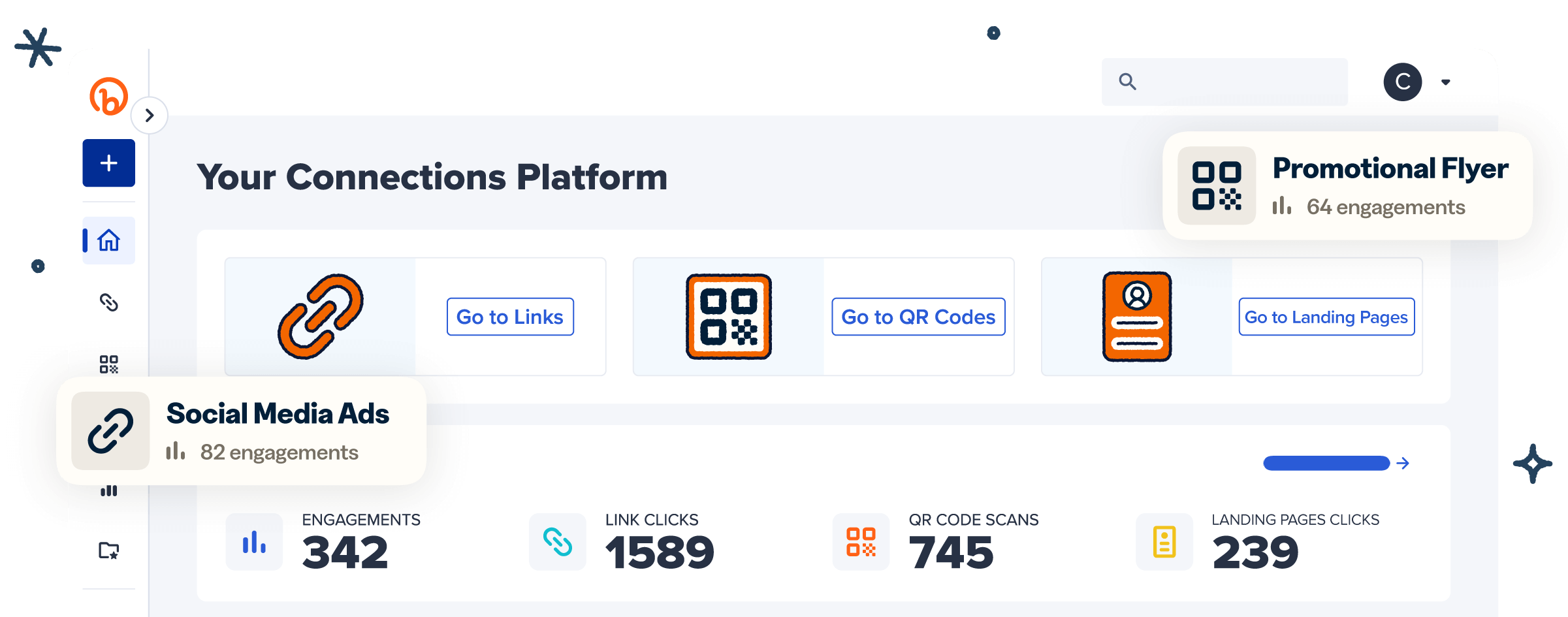
Bitly Analytics acts as the connective layer, bringing link and QR Code performance into a unified view that teams can use to assess campaign health in near real time. Centralized, insight-rich dashboards give teams an opportunity to identify where engagement drops off before those gaps affect revenue.
Connecting link clicks, QR scans, and campaign performance
Bitly Analytics (available with paid Bitly plans) groups performance across Bitly Links, Bitly Codes, and campaign tags, surfacing engagement data by location (city/country), referrer, device, and asset type.
Teams can compare daily QR scan activity across boutique signage, packaging, and direct mail campaigns or see whether a Bitly Code in one market is outperforming the same asset in another.
That level of detail helps teams move beyond surface-level click reporting. Instead of only seeing that a campaign performed well overall, marketers can identify:
- Which assets drive engagement during specific lifecycle stages
- Which markets responded most strongly to physical touchpoints
- Where digital follow-up performed best
That context makes attribution analysis more actionable and budget conversations more defensible.
Distinguishing lapsed buyers from customers still in consideration
Purchase gaps are easy to misread. A customer who hasn’t bought in six months may look like churn on a revenue report. But a customer who has clicked a branded link multiple times in the past 30 days or scanned a boutique QR Code during a recent visit may still be actively evaluating a purchase.
Lifecycle attribution that incorporates recent engagement signals helps teams distinguish genuinely lapsed customers from those still moving through a slow, high-consideration buying cycle.
This distinction influences the message you send, the channel you prioritize, and the offer you make. Treating an active buyer like a win-back candidate can weaken the relationship at a critical stage in the decision process.
Better attribution data starts with better infrastructure
Luxury buying cycles are long, multi-channel, and difficult to capture through last-click reporting alone. Brands that measure them effectively treat boutique signage, direct mail, event invitations, and digital campaigns as connected sources of customer engagement data rather than isolated interactions.
A broader view helps teams understand how discovery, consideration, retention, and advocacy work together across the lifecycle. Bitly Links and Bitly Codes, paired with Bitly Analytics, give marketing teams the infrastructure to act on that view.
Branded short links preserve campaign structure across long journeys, Dynamic QR Codes turn physical touchpoints into trackable signals, and a unified analytics dashboard keeps clicks, scans, and campaign performance in one place. With one comprehensive solution, teams can evaluate attribution more clearly, from first discovery through post-purchase engagement.
Build a more connected attribution strategy across campaigns, channels, and customer touchpoints. Find a Bitly plan for you.
FAQs
Why does last-click attribution fail for luxury retail?
Luxury purchases rarely happen after one decisive interaction because shoppers often research across devices, channels, boutiques, and follow-up content before they buy. Last-click reporting credits the finish line, but it may undercount discovery, consideration, and post-purchase moments that shape lifetime value. Bitly Analytics helps teams compare clicks and scans across channels, making it easier to identify which touchpoints are influencing engagement at different lifecycle stages.
How do you measure attribution across physical and digital luxury retail touchpoints?
Start by assigning unique Bitly Links and Bitly Codes to each channel, asset, boutique placement, event invitation, and packaging experience. That creates trackable clicks and scans for interactions that are often difficult to capture, including direct mail, in-store signage, and care inserts. With Bitly Analytics, teams can review omnichannel performance in one dashboard and spot which combinations support consideration, conversion, and return engagement.
What attribution model works best for high-consideration luxury purchases?
For many luxury brands, a position-based model is a practical starting point because it recognizes both discovery and conversion. Time decay may work better for seasonal launches or private events where recent interactions deserve more weight. If you already have rich first-party data, Bitly Analytics can support model comparisons by showing how links and QR Codes perform across stages.
How do QR Codes support customer lifecycle tracking in luxury retail?
QR Codes turn physical interactions into trackable digital engagement, from window displays and boutique packaging to event materials and authentication experiences. Because luxury journeys often continue after purchase, Dynamic Bitly Codes can connect buyers to care content, provenance details, or loyalty experiences over time. Those scans may help teams better understand customer retention and advocacy beyond the initial purchase.
How can luxury brands distinguish lapsed buyers from customers still in consideration?
Look for recent engagement signals instead of relying only on purchase gaps, especially in categories with long, research-heavy decision cycles. Clicks on branded short links, scans from boutique materials, and repeat visits to curated landing pages can indicate active intent. Bitly Analytics brings those behaviors into a more unified view, helping teams identify re-engagement opportunities without sending win-back messaging too early.